We explain what a mental map is, its characteristics, what it is for and the types there are. Learn how to make one and its advantages and disadvantages.

What is a mind map?
A mind map is a type of diagram that allows you to represent different concepts, words, ideas, readings or tasks, graphically arranged in different ways around a key word or central concept.
Mind maps visually represent the hierarchy of ideas. From a key word or phrase, they derive main concepts, from which secondary concepts or details emerge. In this way, mental maps emulate radiating and associative thinking, since they represent how an idea connects with others in a similar way to what happens in the mind.
This tool aims to present information in a more dynamic way, and therefore facilitates learning, assimilation, analysis, organization and synthesis of different topics. Therefore, mental maps can be used to study, explain, make presentations, take notes, among other tasks.
Features of mind maps
In mind maps, information is organized from most important to least relevant. Therefore, in these schemes there are:
- A central theme or fundamental concept . It is the name of what is going to be described or characterized and is usually placed in the center of the scheme.
- Main concepts or basic organizing ideas . They are the different categories that allow the rest of the information to be classified. They emerge from the central theme or fundamental concept and are usually mentioned with nouns or substantive constructions. They are placed on the lines or in circles or rectangles and it is recommended that they be between three and seven.
- Secondary concepts . They are subcategories, details or examples that emerge from the main concepts or basic organizing ideas. They are placed on lines or in circles or rectangles.
- Lines . They are graphic marks that connect the different concepts. In some cases, they emulate tree branches or neuronal dendrites.
In addition, mind maps usually have other elements:
- Colors . They can be used to make the lines or write the words. They improve the visual representation of information.
- Images . They can be symbols, icons, photographs and drawings that represent the different concepts. They allow content to be easier to process and assimilate.
What is a mind map for?
A mind map can be used for various purposes:
- Explain complex topics.
- Classify simple or complex information.
- Take notes in an organized manner in class.
- Synthesize or summarize texts to make study guides that allow you to better remember the information.
- Organize projects and design business or institutional plans.
- Classify the elements of a brainstorm.
- Make dynamic and didactic exhibitions and training.
- Analyze the characteristics of an issue to be able to make decisions.
- Organize goals and objectives.
- Make a sketch that serves to organize the structure of narrative, expository or argumentative texts.
Types of mind maps and their examples
Mind maps are classified according to their appearance into circular maps, tree maps, rainbow maps and honeycomb maps:
Circular maps
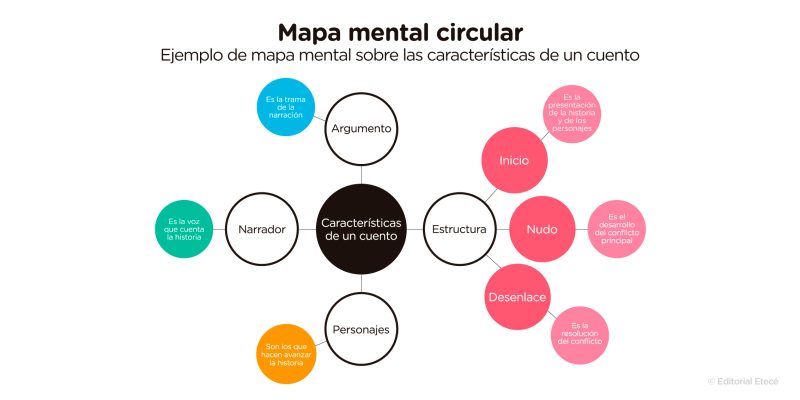
Circular maps are those in which the central theme is placed in a circle in the middle of the diagram. The main concepts or basic organizing ideas are then added into smaller circles, which are connected to the central theme by lines.
In the case of adding secondary concepts, ideas, examples or details, they are placed in circles that are connected by lines with the previous concept and are increasingly smaller as they move away from the central topic.
This scheme differs from the mandala diagram, in which concepts, ideas, examples and details are placed in concentric circles.
Tree maps

Tree maps are those in which the central theme is usually placed in the center of the diagram, but can also be at the top. Concepts, basic organizing ideas, details, and examples are connected by lines that are shaped like tree branches or brain dendrites and become thinner as they move away from the central topic.
This type of scheme was the first mental map: the others are stylistic variations of this first design.
rainbow maps
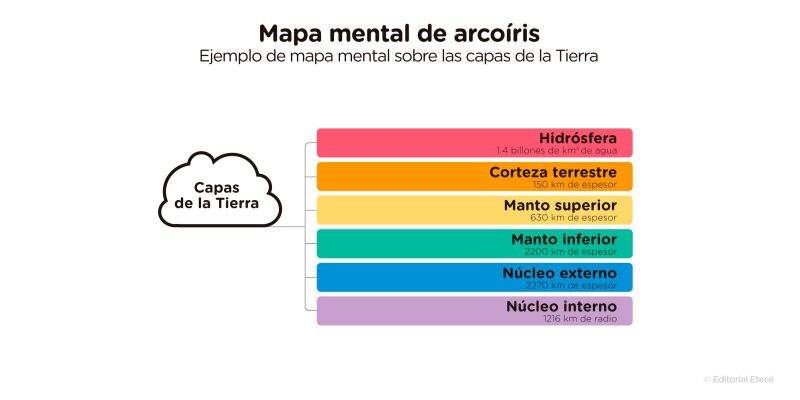
Rainbow maps are those in which the central theme is placed on a cloud to the left. Colored arcs emerge from the cloud to the right and the main concepts are placed in them.
This type of outline has limitations, since secondary ideas and concepts, details, examples or accessory information cannot be added. Furthermore, since the rainbow has seven colors, a maximum of seven main concepts can be added and it is not recommended that there be fewer than five.
Honeycomb Maps
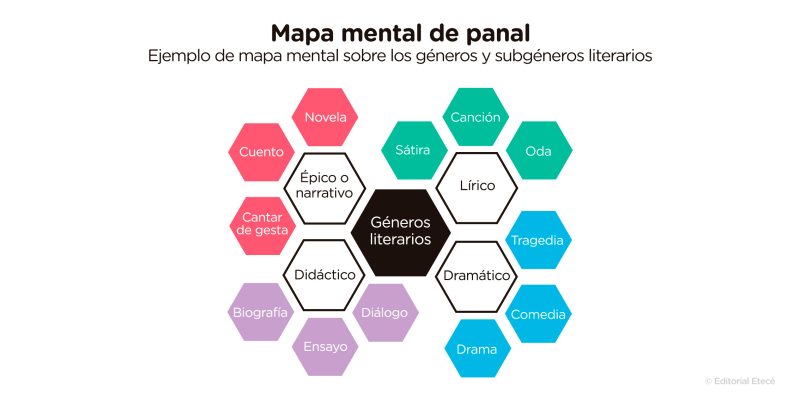
Honeycomb maps are those schemes in which the central theme is placed in a hexagon in the middle of the scheme. From this hexagon others emerge in which the main concepts or basic organizing ideas are added. In the event that it is necessary to add more information, these concepts or ideas are written in hexagons that emerge from the previous one.
This scheme is so named because, when finished, it looks similar to a honeycomb.
How to make a mind map?
When making a mind map to study, teach a class or give a presentation, it is advisable to follow a series of steps:
- Analyze the topic . Generally, the topic is already given by a slogan or a guideline and the main concepts or organizing ideas, secondary concepts, details and complementary ideas must be determined. It is advisable to reference all these items with keywords. For example, the theme can be the characteristics of a story.
- Place the central theme or the fundamental concept. It usually goes in the center of the page and can be written in a circle or a rectangle. For example:

- Place the main concepts or basic organizing ideas . They are placed closer to the central theme and clockwise. It is advisable to write each one with a different color and number them to indicate the reading order. For example:

- Place secondary concepts . They are placed close to the main concept or organizing idea from which they emerge. It is advisable to write them in the same color as the main concept or organizing idea. For example:

- Add tertiary concepts, complementary ideas, details and examples . If there is complementary information, it is placed near the secondary concept from which it starts and with the same color. For example:

- Join the elements . The elements are joined with lines that imitate the shape of brain dendrites or the branches of a tree. If they are closer to the central subject, the lines should be thicker; and if they are further away, they must be finer. Straight lines can also be used and, in that case, all concepts must be in circles or rectangles. For example:

- Add images . It is advisable to add photographs, illustrations, symbols and/or icons that accompany the concepts, since they allow the information to be memorized more easily. Additionally, in some cases, images can replace keywords.
Advantages and disadvantages of the mind map
The mind map has a series of advantages:
- Shows the hierarchy of concepts . It allows you to see the central theme, the main and secondary ideas and the details very clearly.
- Allows you to synthesize the most important information . It serves to highlight the most relevant aspects of a topic, since only the key words of a topic are noted.
- It is useful to assimilate, understand and memorize information . It allows you to understand and remember complex information more easily.
- Helps overcome a mental block . When analyzing or brainstorming, it allows you to overcome blockage because it is an excellent device to encourage creative thinking.
- It can be used in various disciplines and with different objectives . It can be used to study, make exhibitions, teach classes, present projects, among others.
However, a mind map also has disadvantages:
- Can be difficult to prepare . When a person has to make a mind map for the first time, determining how concepts should be organized hierarchically can be very complicated.
- It can be difficult to understand . Since there are no sentences or statements, it can be difficult to understand if a very complex topic is represented.
- It can take a long time to make one . When the topic represented has many classifications and subclassifications, creating the mind map may take longer than expected.
- Usually requires advance planning . So that no key content is left out of the map, it is necessary to determine how the information will be arranged in advance.
- It may not serve to represent a certain topic . Although it can be applied to graph different topics, it is not convenient to use it for those who need to include extensive descriptions.
Difference between mind map and concept map
Mental maps and conceptual maps present some similarities, for example, in both the information appears in a hierarchical manner, it is based on a central theme and the main concepts are mentioned and, in some cases, the secondary and tertiary ones.
However, these types of schemes present differences. On the one hand, only mind maps can be used to organize information that arises at the moment, for example, when brainstorming.
On the other hand, only in concept maps are linking words used, that is, terms or constructions that are written on the lines and that together with the previous and subsequent concepts form a statement with complete meaning.
References
- Buzan, T. (1996). The book of mind maps. Uranus.
- Guerra Reyes, F. (2019). Main graphic organizers used by university teachers: a constructivist strategy. Research and postgraduate, 34(2), 99-118.
- Ontoria Peña, A., Gómez, JPR and de Luque, A. (2006). Learn with mind maps. A strategy to think and study. Narcea.