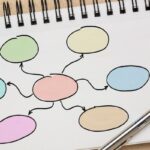
We explain what a concept map is, its elements, characteristics and types. You will know what it is for, how to make one and examples.

What is a concept map?
Concept maps are diagrams that graphically represent links and hierarchy which are among the most relevant ideas on a topic. They are made using concepts (or short phrases) and unions or links.
They are very useful tools for anyone who wants to study or give presentations, since they are a practical way to internalize content and summarize complex information.
The concept map consists of the visual schematization of the key concepts of the topic you are seeking to learn. Concepts are written according to a hierarchical order and connected to each other using lines and linking words, to create a true map of relationships.
Concept maps are widely applied in various study techniques and are recognized for their capacity for synthesis, their visual hierarchy of information and their ease of showing the structure of a topic. It is an extremely versatile tool.
Characteristics of a concept map
A concept map is characterized by the following aspects:
- Visually represents the hierarchy of concepts . The information is organized from the most general concepts to the most particular ones. In this way, complex theories or ideas are easier to understand and assimilate.
- can be read . By joining concepts and linking words, propositions are formed, that is, sentences that allow one concept to be defined with others.
- Allows you to graph cross connections . The lines and arrows not only relate concepts hierarchically, but also show how one subconcept can be linked to another that belongs to a different category.
- Serves as study or exhibition material . It is used as a support to synthesize or summarize texts, theories or projects.
- Promotes meaningful learning . It allows you to start from already known information to add new ones. Furthermore, it expands the knowledge one has about a concept, because it can be redefined by relating it to others.
- Promotes collaborative learning . When a concept map is used as support in a class or a business or institutional meeting, collaboration between individuals is encouraged. In this way, everyone participates in the discovery of how one concept is associated with another and enriches the knowledge they have about a topic.
Elements of a concept map

The elements of a concept map are:
- Concepts . They are mental images associated with specific terms, and are used to denote a specific idea. They are abstract but specific constructions, which have to do with the most important points of the topic to be studied. In concept maps, concepts are referred to in a summary manner, using between one and four words. Two types of concepts can be distinguished:
- A general concept . It is the name of the theme or concept that encompasses others.
- Secondary concepts . They are the concepts that emerge from others. In some cases, these can be short sentences, examples, or details.
- Lines or arrows . They are the graphic marks that link the different concepts in a hierarchical manner or indicating that there are cross connections.
- Linking words . They are words that allow various concepts to be united and indicate the type of relationship that exists between them. They are written on the lines or arrows and mark the reading sequence of the concept map.
- Proposals . They are verbal formulations of a specific idea, that is, the relationship of a concept. This means that propositions are built from concepts and linking words. They form declarative sentences, since they affirm or deny something and can be true or false.
Types of concept map
Some authors consider that a conceptual map is only one that, in addition to concepts and lines or arrows, has linking words that allow propositions to be formed.
However, others maintain that the definition of a concept map is broader, since it can be any diagram that relates, characterizes or explains concepts. According to these authors, there are different types of concept maps:
- Hierarchical concept map . The general concept is placed at the top and center of the diagram. Subordinate concepts are separated downwards according to their relevance or hierarchy. For example:

- Spider concept map . The general concept is placed in the center of the diagram. Subordinate concepts emerge in all directions, that is, up, down, left and right. For example:

- Sequential or flow concept map . The concepts are placed one after the other, to represent that one concept emerges from another in an associative and progressive manner, and not due to its hierarchy. For example:

- Systemic or system concept map . It is similar to the sequential or flow concept map, but has two characteristics that differentiate it. On the one hand, different levels of subordinate concepts can be derived from each concept. On the other hand, it is very common for cross connections to appear between concepts. For example:

What is a concept map for?
Concept maps are mainly used in educational settings, since they are study and learning tools. These diagrams allow you to organize and represent ideas in a different way. interpret an issue in different ways and effectively communicate very complex knowledge, which would require a lot of text to state.
That is why teachers use them to plan classes and subject programs, explain content and evaluate. Students use them to make summaries, take oral exams, give presentations, and learn to analyze concepts instead of studying them by heart.
However, A concept map is considered a complement and not a replacement for reading. and traditional methods of acquiring knowledge, or oral and written expression.
How to make a concept map?
To make a concept map, you must follow the following steps:
- Identify . A question is asked that raises a problem or a possible approach to the topic. In a class or business meeting, this step serves as a trigger for all members to participate. For example: What are the elements of communication? The general concept emerges from this question. For example: The elements of communication.
- Select . Once the focus of the topic or text to be studied has been defined, the most important concepts are written in a list. These concepts should be the main focal points of the topic covered and should not be more than four words. Another option is to write down the concepts on cards, to be able to move them around.
- Group . Sets of concepts are formed according to their proximity or relationship.
- Order . Once the sets are obtained, the concepts are ordered from the most general to the most specific or from the most abstract to the most concrete, to obtain a hierarchy.
- Represent . The concepts are noted, pigeonholing them in ovals, boxes or any shape that allows them to be better visualized and the hierarchy understood: the most general ones can be larger.
- Connect . Once the hierarchy is established and represented, the concepts are interconnected, using arrows or lines on which the linking words must be written.
- Find out . Once everything is finished, the links are read as if they were propositions and it is verified that what they dictate is true, that is, that the meaning of what was intended to be expressed is understood. Possible errors are corrected.
- Reflect . By contemplating the map in its entirety, you can reformulate the knowledge expressed and establish different relationships between the concepts.
Concept map example

Tips for creating a concept map
Some useful concepts for creating a concept map are the following:
- The concepts must be relevant and very brief (it is recommended that they do not have more than four words), since they summarize, synthesize or evoke a set of ideas.
- Linking words must have a clear meaning, since they can express different types of relationships such as causality, reference, integration or definition.
- The concept map must be clear: with a brief look you must understand what is meant and the concepts involved. Therefore, the main concepts should be found in a preferential part of the scheme.
- If the concept map is a synthesis of a text, the writing must be read and analyzed and the key words noted on a sheet of paper. Then you must summarize those words, select the most relevant ones and follow the steps to make the outline. It is not a good idea to make a concept map while reading, since the author may be giving an example or may be raising the prelude to another more important topic.
- Before making the final version of the concept map, it is advisable to make a draft in pencil to be able to introduce all the necessary modifications.
- To facilitate the order of the concepts and the representation of the concept map, the concepts can be written on cards, since it is easy to move them on a table or blackboard as many times as necessary.
History of the concept map
The concept map is a tool that was developed in 1960, following the theories around learning and the acquisition of knowledge by David Ausubel. In 1970 it was successfully implemented by Joseph Novak, who maintained that a concept could only be understood once it had been related to others.
According to Novak, the failure of the traditional educational system is that it only encourages passive reception learning, and the student does not understand the meanings: he only memorizes and repeats information. On the other hand, through concept maps, The student relates directly to the concepts, must make associations and becomes an active subject in the interpretation and the production of knowledge.
Difference between mind map and concept map
Concept maps and mental maps have some similarities. For example, they are useful for presenting information in a hierarchical manner. However, concept maps indicate how concepts are related using lines and linking words. On the other hand, in mental maps only lines are used without reference to the type of connection between the concepts.
Concept maps allow you to create cross connections between concepts and can be read forming propositions. In mind maps, neither of these two tasks is possible.
References
- Berkowitz, D., Rivero, E., Villoch, P., Améstica, J. and Zoro, B. (2017). Systemic Map: looking at the complexity of the territory, beyond academic results. Technical Note No. 9-2017. Educational leaders. Leadership Center for School Improvement.
- Cuevas, AJS (2003). Proposal for the application of concept maps in a blended pedagogical model. Ibero-American magazine of education, 33(2), 1-11.
- Guerra Reyes, F. (2019). Main graphic organizers used by university teachers: a constructivist strategy. Research and postgraduate, 34(2), 99-118.
- Rodríguez Corra, HN (2007). Theoretical foundation of concept maps. Architecture and Engineering Magazine, 1(2).