We explain what population is and the use of the term in demography, statistics and biology. Also, absolute and relative population.

What is population?
The term population is commonly used in different sciences, both natural (for example, biology) and social and formal (especially demography and statistics), but its definition is not always in the same specific sense.
The popular and common use of this word refers to the number of people there at a given time in a place specific. This concept is similar to that used in statistics, which is used for the members of any sample: if we interview 200 European tourists in a spa in Morocco, that is the statistical population.
Demography is the science that studies populations and is interested in the people who inhabit a specific geography. That is to say that the considered as a collective entity with continuity over time whose individuals share characteristics and behaviors that determine that permanence.
A population is, from this point of view, the stock of people in a given region. Population studies are part of different approaches to society, which seek to understand the particular way in which different cultures and nations are organized as well as the particular dynamics that, as a collective, they face.
In this way, it is possible to speak of active population, population at risk, electoral population and an immense etcetera, depending on which point of view is used. Likewise, a historical view of the population provides information, for example, about the quality and way of life of its people at a given chronological moment.
Characteristics of the populations
Very broadly, we can characterize the populations as follows:
- The population is a collective entity, that is, It is made up of a variable number of individuals with certain common demographic traits.
- All population It has a historical moment and a geographical location certain. No population exists in the abstract.
- The populations are “reproductive systems” that is, individuals that die are replaced by young individuals, keeping the number of inhabitants relatively stable. If this number changes, certain explanations can be sought: if it rises, birth rate exceeds mortality or there is immigration; and if the opposite happens, mortality exceeds birth rate or there are emigrations.
- The populations are usually analyzed using statistical techniques and practices which reveal information about your internal tendencies.
Absolute population and relative population

These two terms are usually commonly used in population and demographic studies.
The absolute population is the total number of inhabitants or members of a specific population. When we talk about the number of people in the world, for example, we conclude that we have an absolute population of approximately 7.7 billion people (2020).
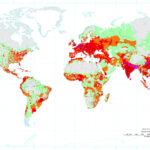
Instead, The relative population refers to the way the inhabitants are distributed within their geographical space or determined territory. Also called population density.
This is calculated statistically, and is expressed in an average number of inhabitants per unit of area, for example: the approximately 7.7 billion people in the world are not distributed equally, so there will be very small countries that are very densely populated, and large countries with very few populations.
The countries with the largest relative population are :
- Monaco. With 19,200 inhabitants per square kilometer of surface.
- Singapore. With 7,720 inhabitants per square kilometer of surface.
- Hong Kong. With 6,646 inhabitants per square kilometer of surface.
- Bahrain. With 1,789 inhabitants per square kilometer of surface.
- Maldives With 1,364 inhabitants per square kilometer of surface.
The countries with the smallest relative population are :
- Mongolia. With 2 inhabitants per square kilometer of surface.
- Australia. With 3 inhabitants per square kilometer of surface.
- Iceland. With 3 inhabitants per square kilometer of surface.
- Namibia. With 3 inhabitants per square kilometer of surface.
- Libya With 4 inhabitants per square kilometer of surface.
Population in statistics
The statistical population is the set of individuals, animals or objects that make up a statistical sample that is, of which it is desired to study their common characteristics or their common behavior, in relative terms or trends. From this study, statistics will be able to draw conclusions and express them in mathematical terms.
Statistical populations can be:
- Finite. That is, limited, like the number of cats in the same park.
- Infinite. Like how many whole numbers we can think of.
But only from finite populations can valid conclusions be obtained, since the statistical procedure starts from taking a representative sample of the total, and it is impossible to do so if the population is unlimited.
Population in biology
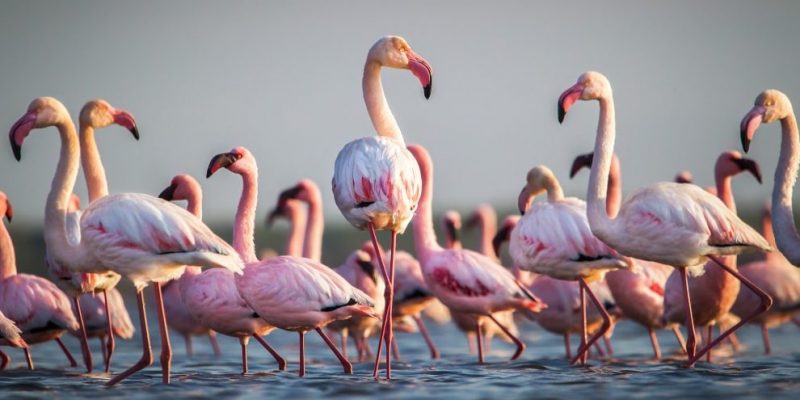
In turn, biology manages its own concept of population. a biological population It is a group of organisms of the same species (whether animal, vegetable, or whatever type) that share space, time and biological properties .
The individuals that make it up reproduce among themselves and have the same ecological interactions and survival requirements.
Continue in: Population in biology
References
- “Population” in Wikipedia.
- “Population density” on Wikipedia.
- “Population” in the Language Dictionary of the Royal Spanish Academy.
- “What is population?” at the National Institute of Statistics of Chile.