We explain what is the day of the race, how was the discovery of America and what are the general characteristics of this celebration.
What is the day of the race?
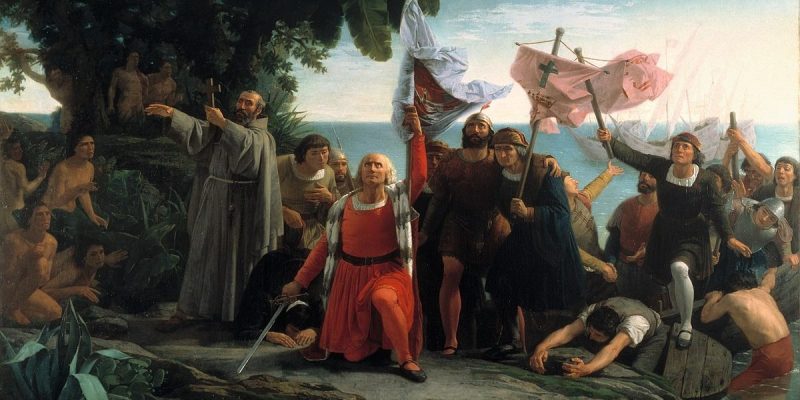
In many Latin American countries, the day of the breed was called the day when The discovery of America by Spanish navigators is commemorated .
This discovery It happened on October 12, 1492 by the crew commanded by Admiral Genoese Christopher Columbus (whose name in Italian was Cristoforo Colombo).
Columbus’s first trip left the port of Palos (Andalusia, Spain) on August 3, 1492 and lasted just over two months. This fact inaugurated a process of conquest of land inhabited by indigenous populations.
The conquest of America It is commemorated both in Spain and in America because it meant an important change in both regions and in world history and influenced the way American countries acquired in the following centuries.
Origin of expression
The expression “Race Day” to commemorate October 12 It was devised by the Spanish minister Faustino Rodríguez-San Pedro . In 1914 that date was celebrated as a “Spanish race party” while in 1915 the term “day of the race” was used for the first time.
The idea behind this celebration was to extol a common breed created between the Spanish conquerors and the Native Americans, the product of the civilizing work of the Europeans. Also I was looking to strengthen diplomatic relations between American nations and Spain and integrate in the same celebration the Creoles with the immigrants who arrived in America at the end of the 19th century and the beginning of the 20th century.
Other denominations for this date
At the moment The name “Race Day” has been replaced by other expressions In most countries that still commemorate the date. In Spain, Hispanidad’s Day has been celebrated since 1958, currently called the National Festival of Spain.
In America, some of these denominations They aim to move away from the racial connotation of the original expression Already highlight the meeting between cultures, that is, diversity instead of the unit, while others celebrate the resistance of indigenous populations against the Spanish conquest. For example:
- Argentina : Day of respect for cultural diversity (since 2010).
- Bolivia : Day of decolonization (since 2011).
- Costa Rica : Day of the encounter of cultures (since 1994, although it is currently not considered a holiday).
- Dominican Republic : Day of the encounter between two cultures and day of cultural identity and diversity.
- Ecuador : Day of interculturality and multinationality (since 2011).
- Mexico : Multicultural Nation Day (since 2020).
- Nicaragua : Indigenous, black and popular resistance day (since 2007).
- Peru : Original peoples day and intercultural dialogue (since 2009, although it is not a holiday).
- Venezuela : Indigenous resistance day (since 2002).
Controversy for the holiday
The original idea of celebrating one day of the breed as the beginning of the Spanish conquest company in America started from a positive assessment of said conquest and relegated indigenous populations to a passive position that hid the acts of violence that characterized the process .
During the celebrations for the 500 years of the arrival of Columbus to America (which took place in 1992) they emerged debates about the way of calling the fact usually referred to as “discovery” . The concept of “two worlds encounter” proposed in those years for UNESCO meant recognizing the importance of Europeans and indigenous people in the cultural exchange that followed the expedition of Columbus. However, this denomination was questioned by the omission of wars and other forms of violence and imposition that crossed the period and determined, in many cases, the destruction of native cultures.
The replacement of the term “race” in the commemoration of October 12 in many countries in America was based on the need to evade the characteristic racism of some European looks over the American indigenous people and in the search to give visibility to native cultures.
The conquest of America
The sponsorship of the Catholic Monarchs
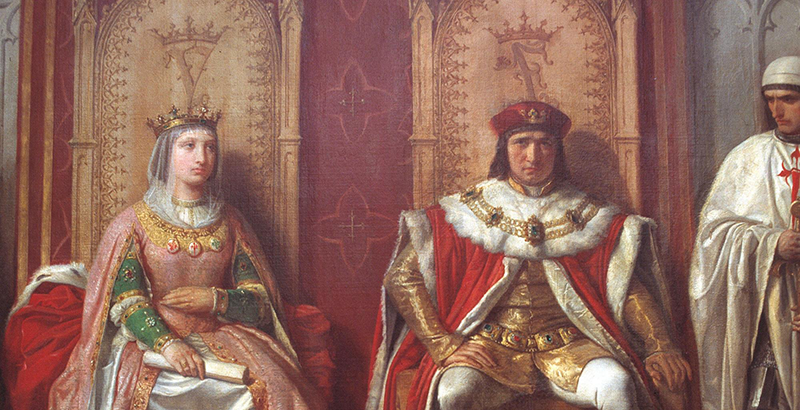
Christopher Columbus He presented his travel project to Fernando II of Aragon and Isabel I of Castilla to whom Pope Alejandro VI called “the Catholic Monarchs.” This denomination was due to the adhesion of both kings to the Catholic faith and their conquest of the territories of the Iberian Peninsula that remained occupied by the Muslims (specifically the kingdom of Granada that was defeated the same year of the arrival of Columbus to America).
Over the years, Catholic Monarchs also attached other territories like the kingdom of Navarra, the Canary Islands and Melilla. His financing of the Columbus expedition was framed in this expansive policy that sought, among other things, extending and controlling the exchange routes.
Columbus project was to reach Asian territory sailing west but the arrival to the American continent – known by Europeans but inhabited by native populations – radically modified the objectives of the Spanish crown and promoted the conquest and colonization of America.
Economic and religious motivations
Spain and other European countries They maintained commercial relations with Asian populations . However, the trips increased commercial exchange, since the Ottoman Empire controlled the Eastern Mediterranean and surrounding the huge African continent was a difficult journey.
The Columbus project aimed to explore an alternative route to reach the Asian territories.
But both Columbus and the Catholic Monarchs also had religious motivations: The objective was not only to expand European trade but also bring Christianity to the pagan populations of Asia. When American land was reached, the exploitation of resources and labor was encouraged but the evangelization of indigenous populations was also promoted.
Detractors of Colón’s trip
The observation that The earth had a spherical shape was spread in all scholarly areas of the fifteenth century. However, in general it was argued that the journey that should be traveled to get to Asia starting a west trip could be much greater than the one required to surround the African continent, so a project like Columbus was, for some, for some, an unnecessary risk.
In addition, it was argued that The advantage of surrounding a continent like the African was that food could be obtained and any other necessary resource just staying close to the coast. On the contrary, navigating west meant traveling great distances in what was supposed to be open sea.
Columbus calculated that the distance between the Canary Islands and Japan was less than 5000 kilometers, while the real distance was 19,600 kilometers. This means that, if the American continent does not exist, The entire crew would have died at sea for not having enough food To complete the path.
The ships and the first sighting
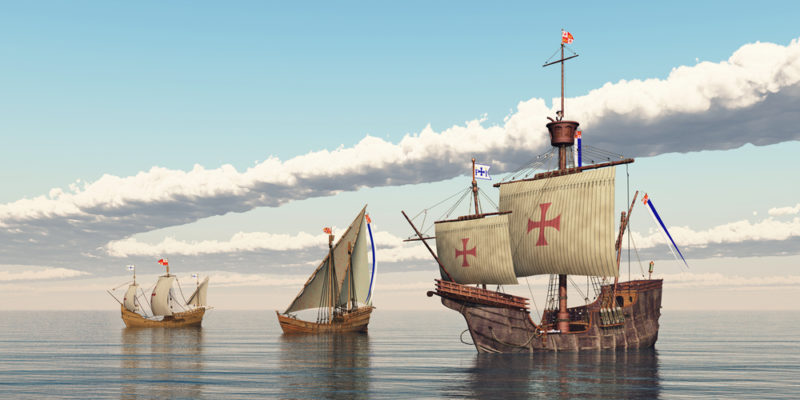
Columbus’s first trip was made by three caravels:
- The Holy Mary . It was the captain boat of the expedition and the largest (some researchers believe it was not a caravel but a NAO), with more than thirty crew. Its wood was used to build the first Spanish settlement in America, the strong Christmas in its Spanish.
- The girl . It is believed that he had less than twenty crew.
- Pinta . It is believed that it had about twenty -five crew.
The first European in seeing American land was Rodrigo de Triana, a sailor from the Pinta . It was at two in the morning of October 12. The observed land was the Guanahaní Island in the Antilles. It is currently believed that Viking populations arrived in American territory long before, but they did it at the northeast end of the continent.
The names of America
Upon arriving at the Antilles, Columbus believed to have arrived in Asia, which is why America was known as “Las Indias” (Subsequently Western Indies) and its inhabitants as “Indians.” He was also given the name of “The Antipodes” and the Portuguese adopted the terms “Vera Cruz” and “Tierra de Santa Cruz” to refer to the coasts of Brazil.
When it was clear that it was a previously unknown continent, He happened to know it as “New World” . He acquired the name of America in 1507 in honor of Américo Vespucio, the first explorer who seems to have argued that those lands corresponded to a different continent of Asia.
})
References
- “Cristóbal Colón” at https://www.cervantesvirtual.com/
- “Christopher Columbus” Flint, Vij (2022) at https://www.britannica.com/
- “October 12 in the collective memory” http://ravignani.institutos.filo.uba.ar/