
We explain why the Suez Canal crisis was unleashed and what countries were involved. In addition, its political importance and its consequences.
What was the Suez Canal crisis?
The crisis of the Suez Canal (1956) also known as the Sinai War, It was a war conflict between the United Kingdom, France and Israel against Egypt . The crisis was triggered when the Egyptian president, Gamal Abdel Nasser nationalized the Suez channel company for the benefit of the Egyptian economy and to the detriment of foreign interests of British and French private companies.
In turn, this crisis occurred within the framework of the Arab-Israeli conflict initiated in 1948, with the creation of the State of Israel and the expulsion of the Arab population from the ancient territory of Palestine. In this context, Egypt had established an alliance with Syria and Jordan against Israel.
When the Suez Canal crisis, the United Kingdom, France and the state of Israel unleashed the invasion of Egypt and unleashed the Sinai War. In a few days, the international community repudiated the attack and, under the strong pressure of the United States, the attackers had to withdraw their troops.
When the Suez channel crisis ended, the international political influence of the United Kingdom and France was weakened. Instead, Egypt was strengthened and Nasser became one of the most important leaders of Arab nationalism .
Background of the Suez Canal Crisis
The Suez channel is an artificial channel that joins the Mediterranean Sea with the Red Sea. It was built in the second half of the nineteenth century and located within the borders of Egypt. In addition, the canal borders the Sinai Peninsula, which unites Africa and Asia.
The passage of the Suez channel is essential for the oil supply of the western countries, since allows navigation between Europe and South Asia without having to surround the African continent.
Since its construction, the channel is owned by the Egyptian government . However, since then and throughout the first half of the twentieth century, it was under the usufruct of a concessionary company of European shareholders (the majority British and French).
In 1956, Gamal Abdel Nasser was elected president of Egypt. Nasser was a nationalist politician who promoted the political and economic development of the country through a program of “Arab socialist nationalism.” Was against European colonialism of the region and In favor of autonomy and self -determination of Arab peoples .
On the other hand, Egypt needed financing for the construction of the Asuán dam, a fundamental work for the growth of the Egyptian economy. The World Bank agreed to a loan with the condition that other countries such as guarantor financiers were presented.
The governments of the United States and the United Kingdom had promised to finance a part but in July 1956 they denied their financial support in reparation for the ties that Egypt was filing with the Soviet Union and Czechoslovakia.
How did the Suez channel crisis unleashed?
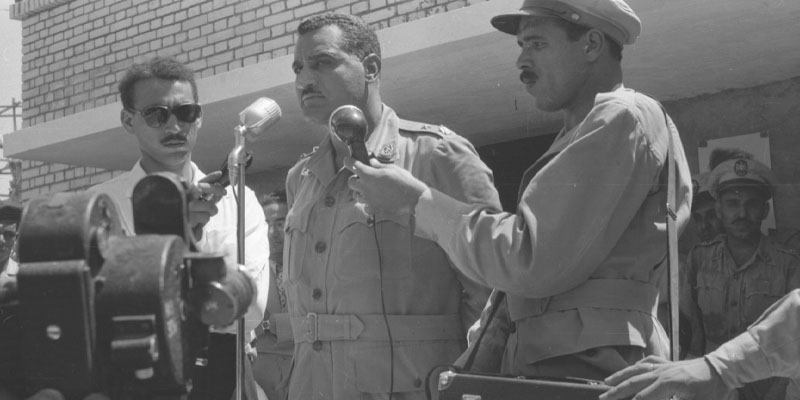
Before the refusal of the United States and the United Kingdom to support the financing of the construction of the Asuán dam, Nasser reacted with the nationalization of the Suez channel.
It was estimated that the construction project of the Asuán dam could be financed with the five -year profits of the Suez Canal usufruct. On July 26, 1956, Nasser declared martial law in the Canal Zone and took control of the Suez Canal Company.
In addition to wanting to recover the economic benefits they received from the Suez channel, The United Kingdom and France feared Arab nationalism preached by Nasser and, For this reason, they sought to overthrow the government of the Egyptian President. In order to do so, they went to the state of Israel (enemy of Egypt for the Arab-Israeli conflict) to obtain a pretext and make a military intervention.
The Sinai War
On October 29, 1956, The state of Israel invaded the Sinai Peninsula . On November 5, the British and French forces landed in Port Said to occupy the Suez Canal and ensure commercial traffic.
However, The attack was repudiated by the international community and, especially, by the United States. Finally, under strong pressures from the United States and the UN, the United Kingdom and France agreed to stop the invasion the next day and withdraw their troops after one month.
Consequences of the Suez Canal Crisis
These events affected the political force of the United Kingdom and France. It was found that they were unable to act on the international stage without the support of the United States . In addition, this defeat led to the resignation of the British Prime Minister, Anthony Eden.
On the other hand, Nasser had been able to reject the attack of the United Kingdom, France and the problematic state of Israel. The Suez Channel Crisis made Nasser one of the most important leaders of Arab nationalism .
Continue with:
References
- Britannica, The Editors of Encyclopaedia (2023). “Suez Crisis”. Britannica Encyclopedia
https://www.britannica.com/ - Palmowski, J. (2000). “Suez Crisis”. To Dictionary of Twentieth-Century World History. Oxford University Press.
- Van Dijk, R., Gray, WG, Savranskaya, S., Suri, J., & Zhai, Q. (eds.). (2013). “Suez crisis.” Encyclopedia of the Cold War. Routledge.


