
We explain what was the Egyptian-Israeli peace treaty of 1979 and who were its protagonists.

What was the Peace Treaty between Egypt and Israel of 1979?
The peace treaty between Egypt and Israel It was the treaty that ended a long period of conflicts and wars between the two countries that had begun with the creation of the state of Israel in 1948.
It was signed on March 26, 1979 in Washington USA. His signatories were Israeli Prime Minister Menájem Beguín, Egyptian President Anuar El-Sadat and US President Jimmy Carter, who promoted the approach between the two leaders and measured in the negotiations.
The immediate background of the Treaty was the Camp David agreements, signed by the three leaders in Washington on September 17, 1978. The main clauses of the treaty were the Establishment of peace and diplomatic relations between Egypt and Israel, the return of the Sinai Peninsula to Egypt and he Egyptian recognition of the state of Israel .
Key points
- The peace treaty between Egypt and Israel was signed in 1979 by the Egyptian President Anuar El-Sadat, the Israeli Prime Minister Menájem Beguín and, as a witness, US President Jimmy Carter.
- The peace treaty between Egypt and Israel formally ended the state of war between the two countries. Israel accepted the return of the Sinai to Egypt and the border demilitarization was agreed with the supervision of a multinational force.
- After the signing of the Peace Treaty with Israel, Egypt was suspended from the Arab League and, in October 1981, President Sadat was killed by a jihadist group. The Arab League admitted again in Egypt in 1989.
The historical context
After the end of World War II (1939-1945), the UN (United Nations Organization) decided the partition of the British Palestinian mandate in two states: one Jewish and another Arab. However, the Arab League rejected the plan and, when the British mandate concluded In 1948, Jewish leader David Ben Gurion proclaimed the creation of the state of Israel .
This fact began the First Arab-Israeli War (1948-1949), which faced the newly created state of Israel with neighboring Arab countries: Egypt, Syria, Transjordan, Lebanon and Iraq. After the Israeli victory, other conflicts occurred in a series of wars between Egypt and Israel, which sometimes also involved other countries: the Sinai War, Also known as Suez Canal Crisis (1956), The Six Day War (1967) and the Yom Kippur War (1973).
After the 1973 War, the governments of Egypt and Israel agreed to cease fire and an agreement to separate their military forces with the assistance of the UN. In 1977, Egyptian President Anuar El-Sadat that had diplomatically approached the United States, He made a historic visit to Jerusalem .
In 1978, Sadat and Israeli prime minister, Menájem Beguín, met at the presidential residence of Camp David, in the United States, where they held peace conversations with the intermediation of US President Jimmy Carter. From these conversations arose The Camp David agreements that put the foundations for the signing of the peace treaty between Egypt and Israel of 1979.
Protagonists of the peace treaty between Egypt and Israel
Anuar El-Sadat (1918-1981)

Anuar El-Sadat was an Egyptian military who held the presidency of Egypt from 1970 until his death in 1981. He was the first Arab leader who began peace negotiations with Israel . These negotiations concluded with the signing of the Camp David agreements in 1978 and the peace treaty between Israel and Egypt in 1979. In 1978 he was awarded the Nobel Peace Prize.
Graduated at the Cairo Military Academy in 1938, he joined the organization of Gamal Abdel Nasser -free officers, He participated in the coup d'etat that overthrew the monarchy in 1952 and supported Nasser's rise to the presidency in 1956. He was his vice president in two periods (1964 and 1969-1970). When Nasser died in 1970, he agreed to the presidency of the country .
Sadat considered that the Soviet support received since the years of Nasser's presidency had been insufficient for the fight against Israel. For this reason, it began a reorientation of Egyptian foreign policy in a pro-western sense. In 1972 he expelled thousands of Soviet technicians and advisors.
In October 1973, Sadat launched an attack against Israel with Syria that after the six -day war of 1967 he had taken over territories that had previously belonged to Arab countries, such as the Sinai Peninsula to Egypt. Although at the end of this conflict, known as Yom Kippur War, Israel recovered the territories initially lost to Egypt and Syria, Sadat achieved great prestige in the Arab world for its confrontation with Israel.
Simultaneously, the oil countries of the OPEC (Organization of Petroleum Exporting Countries) agreed to an increase in oil prices in 1973 as retaliation for the support of Western powers to Israel, which triggered a deep economic crisis in the western capitalist economy.
After Yom Kippur war, Sadat restored diplomatic relations with the United States government On November 7, 1973 and promised the policy of “small steps” defended by the Secretary of States of the United States, Henry Kissinger, which consisted of establishing diplomatic contacts with the enemy country to gradually surpass mutual differences.
In November 1977, Sadat made a historical visit to Israel and defended his peace plan against Knéset (the Israeli Parliament). The president of the United States, Jimmy Carter, On September 17, 1978. On March 26, 1979, the peace treaty between Egypt and Israel, the first treaty signed between the state of Israel and an Arab nation was signed in Washington.
Thanks to this treaty, Egypt recovered the Sinai Peninsula and obtained the economic aid of the United States. However, The Egyptian government was condemned and boycotted by the other Arab states and Sadat faced a strong internal opposition.
Finally, during a military parade commemorating Yom Kippur's war on October 6, 1981, Sadat was killed by the Egyptian Islamic Yihad group .
Jimmy Carter (1924-)
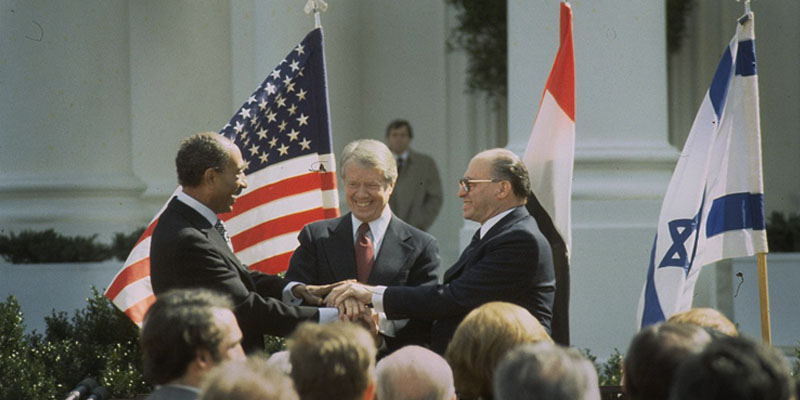
Jimmy Carter was an American politician, a member of the Democratic Party, who served as a senator between 1963 and 1967 and Governor of Georgia between 1971 and 1975. In the 1976 presidential elections he beat Republican President Gerald Ford, who had replaced Richard Nixon after the Watergate scandal. He exercised as president of the United States between 1977 and 1981 .
Carter's foreign policy proclaimed as main objective the defense of human rights . However, the needs of a power policy entered into contradiction for this purpose. This contradiction was reflected in his appointment of Cyrus Vance, a liberal, as Secretary of State, and Zbigniew Brzezinski, an emigrated anti -communist from Poland, as Minister of National Security.
Carter made that in 1978 the Congress approved the agreement for the American withdrawal of the Panama Canal Zone and in 1979 he established diplomatic relations with the People's Republic of China.
In Latin America, he only obtained mediocre results in his human rights promotion policy. His great success was his mediation for the signing of the Camp David agreements Between the Egyptian president Anuar El-Sadat and the Israeli Prime Minister Menájem Beguín in 1978, followed by the peace treaty between Egypt and Israel in 1979.
The problems of the presidency of Carter emerged that same year with the Islamic revolution in Iran, the assault on the US embassy in Tehran and the hostage taking. To free them the US army organized a risky rescue plan that ended in a real failure in April 1980.
Despite signing the Salt II agreements with the Soviet Union for Armament Reduction, Carter Military spending increased and promoted the deployment in Western Europe of the so -called “Euromisiles” (American Pershing and Cruise missiles) In response to Soviet SS-20 missiles deployed in Eastern Europe.
The Soviet invasion of Afghanistan in December 1979 led Carter to decree the seizure of grain exports to the Soviet Union, to boost the boycott of the 1980 Olympic Games in Moscow already state the so -called “Carter Doctrine” for which the president promised a military reaction of the United States in case of aggression in the Persian Gulf, where he had interests for access to oil.
However, The hostage crisis in Iran weakened Carter's position And, in the 1980 elections, he was defeated by Republican candidate Ronald Reagan. In 2002, Jimmy Carter received the Nobel Peace Prize.
Menájem Beguín (1913-1992)
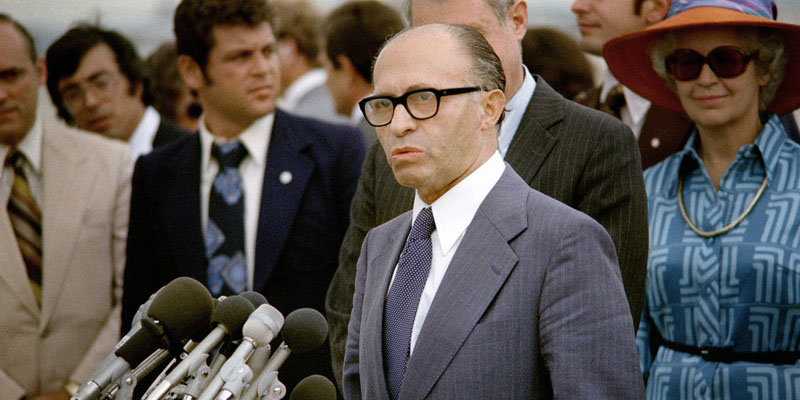
Menájem Beguín was born in Brest-Litovsk, at that time in the Russian Empire, in 1913. Zionist from his youth (that is, supporter of the creation of a Jewish state), It was enrolled in the Extrem Right Youth Movement Betar . In 1938 he became the leader of this organization and dedicated himself to the military training of his militants.
When World War II broke out in 1939, he fled to Vilna (in the current Lithuania), was arrested in 1940 by the NKVD (Soviet Secret Police) and was sentenced to eight years in a work camp in Siberia. However, he was released in 1941, joined the Eastern Polish army and traveled to Palestine in 1942.
Over there It became the leader of the Irgún, a Zionist paramilitary organization . Between 1943 and 1948, Beguín He led the organization and ordered many of its actions, such as the blasting of the King David Hotel in Jerusalem in 1946 or the massacre of the Palestinian Arab people of Deir Yassin in 1948.
Beguín's radicalism faced him with the main Zionist leader, David Ben-Gurion, which caused a political-ideological breakup and a personal resentment between both leaders that lasted many years. After the constitution of the state of Israel in 1948, Irgún's forces joined the Israel Army .
Beguín went to political action with the foundation of the Herut Party (Libertad), and directed the conservative opposition to the hegemony of the Labor Party that ruled the state of Israel during the first three decades. In 1965, Beguín merged his Herut party with the Liberal Party, a fusion that served as the basis for the future Likud party.
In the 1977 elections, the Beguín Likud party obtained 43 seats in the Knéset (the Israeli Parliament), compared to 32 of the Labor Alignment. Beguín held the position of Prime Minister For six and a half years, from June 1977 to October 1983.
After thirty years of Labor Government, his party also sought, although with little success, relieve centralization and liberalize the economy. He also intensified the national campaign for the right of Soviet Jews to be repatriated to Israel and gave the orders for the evacuation of the Jewish community of Ethiopia, which took place only some years later.
Beguín's main achievement was the signing of the peace treaty between Egypt and Israel with the mediation of the president of the United States, Jimmy Carter. In November 1977, Five months after Beguín assumed as prime minister, Egyptian President Anuar El-Sadat visited Jerusalem.
This visit began two years of negotiations that culminated with the Camp David agreements in 1978, which resolved the Israeli withdrawal of the Sinai and the establishment of a Palestinian autonomy in exchange for the Egyptian recognition of the state of Israel and the beginning of normal relations with Egypt.
Prime Minister Beguín and President Sadat were distinguished with the Nobel Peace Prize in 1978 and, on March 26, 1979, the peace treaty between Egypt and Israel was signed.
However, Beguín practiced a hardness policy with the other enemy countries of Israel . In 1981 he ordered the bombardment of Osirak's nuclear reactor, near Baghdad, in Iraq, and proclaimed the annexation of the Golán Syrians.
Besides, decided the execution of two military operations on Lebanon : The 1978 Operation Litani and Operation Paz for Galilee of 1982. Both operations were intended to evict the PLA (Palestine Liberation Organization) of the south of Lebanon. The second operation originated the War of Lebanon (1982-1985) and motivated a broad international condemnation of Israeli politics.
The health problems, the death of his wife and the international complications that triggered his intervention in Lebanon led Menájem Beguín to resign his position in October 1983. He died in March 1992 at the age of 78.
The peace treaty between Israel and Egypt
The peace treaty between Egypt and Israel He was signed in Washington on March 26, 1979 . His signatories were the President of the Arab Republic of Egypt (Anuar El-Sadat), the Prime Minister of the State of Israel (Menájem Beguín) and the president of the United States (Jimmy Carter).
The treaty It was the result of long negotiations Started years ago. In 1978, the leaders of the countries involved had signed the Camp David agreements, in which they had committed to negotiate a peace treaty such as the one they finally signed in 1979. Then some fragments of this treaty are offered.
Peace Treaty between the Arab Republic of Egypt and the State of Israel
March 26, 1979
“The Government of the Arab Republic of Egypt and the Government of the State of Israel,
Convinced of the urgent need for establishing a fair, broad and lasting peace in the Middle East in accordance with resolutions 242 and 338 of the Security Council;
Reaffirming its adhesion to the “Agreement-Marco for Peace in the Middle East agreed in Camp David” on September 17, 1978;
Noting that the aforementioned-Marco Agreement, as appropriate, aims to constitute a base for peace not only between Egypt and Israel, but also between Israel and each of its other Arab neighbors who are willing to negotiate peace on this basis;
Wishing to put an end to the state of war between them and establish a peace in which all the states of the area can live safely;
Convinced that the conclusion of the peace treaty between Egypt and Israel is an important step in the search for broad peace in the area and for the achievement of the end of the Arab-Israeli conflict in all its aspects;
Inviting the other Arab parts of the conflict to join the peace process with Israel, guided and based on the principles of the aforementioned-marco;
Also wishing the development of friendly relations and cooperation between them in accordance with the Charter of the United Nations and the principles of international law that govern international relations in peace times;
They agree on the following provisions in the free exercise of their sovereignty in order to implement the “-Marco Agreement for the celebration of a peace treaty between Egypt and Israel”;
Art. 1. 1. The state of war between the parties will end and peace will be established between them when the instruments of ratification of this treaty are exchanged.
2. Israel will withdraw all its armed forces and civilians from the Sinai behind the international border between Egypt and the Palestine under mandate, as provided in the annexed protocol (…), and Egypt will resume the exercise of its full sovereignty over the Sinai. (…)
Art. 2. The permanent border between Egypt and Israel is the international border recognized between Egypt and the old territory under the mandate of Palestine (…), without prejudice to the matter of the status of the Gaza Strip. The parties recognize the inviolability of this border. Each will respect the territorial integrity of the other, including its territorial waters and airspace.
Art. 3. 1. The parties shall apply among them the provisions of the United Nations Charter and the principles of international law that govern relations between states in peacetime. (…).
Continue with:
References
- Britannica, Encyclopaedia (2023). Anwar Sadat. Britannica Encyclopedia. https://www.britannica.com/
- Britannica, Encyclopaedia (2023). Jimmy Carter. Britannica Encyclopedia. https://www.britannica.com/
- Britannica, Encyclopaedia (2023). MENACHEM BEGIN. Britannica Encyclopedia. https://www.britannica.com/
- Dergoussian, K. (2017). Everything you need to know about the conflict in the Middle East. Paidós.
- Peace treaty between Egypt and Israel, March 26, 1979, in: A Peacemaker. https://peacemaker.un.org/
- Wright, L. (2014). Thirteen Days in Septern: Carter, Begin, and Sadat at Camp David. Knopf.


