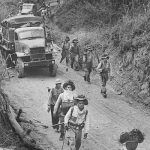
We explain what the war in Algeria was and how Algerian anti -colonial nationalism faced the French colonial authorities.
What was the war in Algeria?
The Algerian War, also known as the War of Liberation of Algeria, was a military conflict that happened between 1954 and 1962, in which Algerian anticolonial nationalism faced against the French colonial authorities . This war is part of the decolonization process of Africa in which the population of the ancient European colonies fought to free themselves from the foreign government and achieve political independence.
The war for the independence of Algeria constituted One of the bloodiest processes of African decolonization . It began when the National Liberation Front (FLN), grouped the different nationalist factions and began guerrilla attacks against the French government.
The FLN sought diplomatic recognition and support from the United Nations Organization (UN) to establish the National Sovereignty of Algeria. The colonial authorities resisted the progress of nationalism And, even, the orders of the president of France when the metropolis sought to end the conflict and initiate the treatment of the country.
The confrontation lasted almost eight years and He took the lives of more than 500,000 Muslim Algerians and about 25,000 French soldiers . He ended in 1962, with the signing of the Evian agreements, the declaration of the independence of Algeria and the withdrawal of the French authorities and troops of the country.
Background of the Algerian War

Algeria was a colonial possession of France since 1830 and by 1954, It had become the largest French colony . The colonial population of European origin in Algeria reached a million inhabitants, within a total of 9 million Algerians, mostly Muslims. European settlers enjoyed a high quality of life, thanks to political, economic and social privileges as a result of the colonial order.
Instead, the rest of the Algerian population had to pay a high tax quota of which it did not enjoy the benefits. The Algerians also did not have the same political rights as European settlers and a limited citizenship were awarded. In addition, they did not reach elementary educational levels and lived in very poor socio -economic conditions.
At the end of World War II, the Asian and African decolonization process was deepened. In 1945, thousands of Algerians gathered in the city of Setif to claim national independence .
The colonial government harshly repressed the protesters for several days and it is estimated that it murdered between 6,000 and 20,000 Muslim Algerians. The Setif massacre became a symbol of colonial horror and strengthened Algerian nationalism in the population.
The National Liberation Front (FLN) was founded in March 1954 by a group of young Muslim nationalists who questioned traditional nationalist parties for their inoperance and inability to defend the rights of Algerians. The initial group was known as “The Historic Nine” and among its leaders were the main Algerian nationalist militants: Mohamed Boudiaf, Mustapha Ben Boulaid, Rabah Bitat, Larbi Ben Mhidi, Mourad Didouche, Mohamed Jider, Ait Ahmed and Ben Bella.
Development of the Algerian War
Direct hostilities began on November 1, 1954, when FLN declared the war against France publicly and officially. The FLN military arm was the National Liberation Army and was commanded by Houari Boumedienne.
In Tunisia and Morocco (neighboring countries that were also French colonies) nationalist rebellions managed to obtain their independence in 1956 and 1957, so France concentrated its efforts in Algeria, its most important colony . For their part, these countries that had achieved their independence supported the FLN guerrillas and the Algerian nationalist army could settle their military bases in their territories. In this way they were out of the reach of the colonial authorities.
During the war, the greatest guerrilla activity of FLN was inside and, especially, on the border. However, the most brutal clashes were in the city of Algiers between 1956 and 1957. During the “Great Repression of Algiers”, the French authorities began a repressive wave with the aim of dismantling the FLN and maintain the country's colonial control.
To do so, the colonial authorities carried out extremely brutal measures that deeply affected their legitimacy (in Algeria, in France already international level). The repression of the civilian population implied clandestine arrests, systematic torture and public executions . This led to more and more Algerians to support the FLN guerrillas.
In 1959, Charles de Gaulle (President of France) recognized the right of Algeria to his national sovereignty. However, the colonial authorities in Algeria radicalized their position, disagree with the orders of France and tried to maintain power through the war for another three years. This had deep consequences even in France's internal policy (which triggered the end of the fourth French Republic).
RESULTS OF THE ALGELIA WAR

The FLN guerrillas managed to weaken the colonial authorities and De Gaulle managed to impose himself on the colonialists of Algeria . In 1962, negotiations between the nationalists and the government of France began, which led to the signing of the Evian agreements in March of that year. On July 3, the independence of Algeria was officially declared, recognized by the UN in October.
Once independence was obtained, a provisional government was established in Algeria. However, FLN leaders had different ideas about how the new government should be and who should lead the country's transition to an independent political, economic and social structure.
In 1963, Ben Bella managed to impose himself on the other leaders and obtained most votes To lead the new single party government. In May he assumed as Prime Minister of Algeria. However, two years later he was overthrown by Boumedienne, who maintained his presidency until 1978. During his government, FLN as a party lost influence and the power was concentrated in the hands of Boumedienne and his closest ministers.
Boumedienne built the foundations of Islamic socialism in her country . On the economic level, he promoted industrialization and nationalized the exploitation of some of the most important natural resources in the country. On the social level, he dealt especially with improving the educational level of the population through the foundation of schools and professional training spaces.
Continue with:
References
- Millett, Allan R. (2023). “Algerian War”. Britannica Encyclopedia https://www.britannica.com/
- Palmowski, J. (2000). “Algerian War of Independence”. To Dictionary of Twentieth-Century World History. Oxford University Press.
- Suh, DS (1988). Kim Il Sung: The North Korean Leader. Columbia University Press.
- Van Dijk, R., Gray, WG, Savranskaya, S., Suri, J., & Zhai, Q. (eds.). (2013). “Algeria.” Encyclopedia of the Cold War. Routledge.