
We explain what were the main battles of the First World War, what were its characteristics and its results. In addition, its protagonists.

What was World War I?
World War I was An international conflict that happened mainly in Europe and developed for four years, Between 1914 and 1918 . The faced sides were the central empires (headed by Germany, Austria-Hungary and the Ottoman Empire) and the entrance or allies (France, the United Kingdom, Russia, Italy and the United States).
The war began shortly after the murder in June 1914 of Archudique Francisco Fernando, heir to the Austro -Hungarian throne, and initially took the form of a war of movements driven by the German advance towards France through Belgium. When the German advance was arrested in the western front, the conflict became mainly a trenches war . Finally, the entrance was victorious.
The battles of the First World War introduced some technical and technological novelties to a large extent due to the development of the second industrial revolution, such as the military use of tanks, airplanes and submarines or the use of toxic gases . The total balance of fatal victims was immense: almost nine million combatants and seven million civilians. In addition, he left twenty million injured and mutilated.

- See also: Chronology of World War I
The Battle of Tannenberg (1914)
A few days after the war began in August 1914, while the Germans advanced on the western front, Russian General Aleksandr Samsonov attacked oriental Prussia .
The initial Russian successes led the German leaders to replace General Maximilian von Prittwitz and to send the generals Paul von Hindenburg and Erich Ludendorff to deal with the Russian invasion. On August 28, the Germans surrounded the Samsonov army.
The battle ended on August 30. The Russian disaster was total : 150,000 soldiers only escaped healthy and saved 10,000. The Germans took more than 92,000 prisoners and the dead were around thirty thousand. Samsonov, overwhelmed by defeat, committed suicide.
- See also: Military Chiefs of World War
The Battle of Marne (1914)
After the initial successes of the German attack on France through Belgium, The French government fled to Bordeaux And more than 500,000 Parisians left the city, which seemed about to be taken by German troops.
General Joseph Joffre managed to reorganize the French troops and the small British expeditionary body, and on September 6, 1914 He directed a counteroffensive along the Marne River that forced the Germans to go back .
The battle ended on September 10 and the German troops continued the withdrawal during the following days. The human cost was more than 200,000 casualties for the French army and a similar number for the Germans.
The allied victory in the Marne had stopped the German attack . From now on, the western front stabilized over almost four years. All attempts to break the front caused huge human losses and barely got small advances of a few kilometers.
The Battle of Galipoli (1915-1916)
By proposal of Winston Churchill, who at that time was the position of First Lord of the Admiralty, The British devised the Dardanelos campaign. Planned to attack the Ottoman Empire the allegedly weaker ally of the central empires, to distract the attention of the Western front and relieve pressure on the Russians in the Caucasus.
The campaign began with an attack on the Dardanelles in February 1915 and continued with a landing in the Galipoli Peninsula in April. However, After several months, it ended in a complete failure for the entente .
The British, Australians and New Zealand who participated in the campaign suffered almost a quarter of a million casualties, with almost fifty thousand dead. The French had almost 50,000 casualties, with five thousand dead. For the Turks, the campaign left a balance of 250,000 casualties, with more than 60,000 dead.
- Can serve you: World War I alliances
The Battle of Verdún (1916)

February 21, 1916, German soldiers put into practice the tactics of the “War of wear” designed by General Erich von Falkenhayn and They attacked the fortified square of Verdún. The idea was to concentrate a huge army in Verdún, force the French army to gather all his troops there to defend himself and cause him massive casualties to overcome him.
After months of fierce fighting, The French resistance, directed by Philippe Pétain, made the German attack not achieve significant advances . Pétain had established a troops and supply rotation system to reduce the amount of French casualties.
The Battle of Verdún ended in a kind of draw on December 18, 1916. It was the longest battle and one of the most devastating World War .
The French managed to stop the German offensive with a cost of more than half a million casualties. The Germans mobilized one million soldiers and had around 450,000 casualties. It is estimated that Around three hundred thousand men lost their lives in Verdún .
The trenches war
The war of movements of the first months of war, which meant the rapid advance of German troops and the general mobilization of troops, soon came to an end. On the masses of infantry and cavalry tons of grenades fell, and thousands of gusts of machine gun decimated the ranks.
After the battle of Marne, in which the French managed to stop the German advance, The armies had to hide and dig trenches systems more and more complex to survive the enemy fire. From the North Sea to Switzerland, Thousands of kilometers of trenches faced millions of men in the Western front . Mud covers, infected with rats, the trenches became the home of the soldiers.
The repeated attempts of the military for breaking the front led to true killings, such as those that took place during the battles of Verdún, the Somme and Passchendaele. The industrial powers struggled to find new weapons that allowed the breakdown of the front: the Germans began in 1915 the chemical war and the English in 1917 the massive use of tanks, while aviation began to be systematically used as a weapon of war.
The chemical war

The use of toxic substances in the war had been prohibited by the Hague Conference in 1899. However, when the fronts of the First World War stabilized, the Germans, who had a highly developed chemical industry, They thought of this type of weapons as a solution to end the trenches war .
At five o'clock in the afternoon of April 22, 1915, on the front of Ypres in Belgium, The German troops took advantage of the favorable wind, opened bottles of chlorine and a toxic cloud headed towards the French lines . The surprise and panic were total. After successive attacks, the Germans got sixteen kilometers in a few days.
The chemical and arms industry of both sides began the production of new gases (Fossgen, xylene bromide, arsenic, cyanhydric acid, mustard gas). The repertoire of toxic substances was expanded.
The gases began to be launched in artillery bombs to prevent a sudden wind change from making the troops themselves asphyxiated. The armies developed defense and alarm systems. The soldiers had to provide them with antigás masks .
The Battle of the Somme (1916)
After the offensive of the German general Erich von Falkenhayn in Verdú A great maneuver to relieve the position of the fortified city of Verdún .
The first day of the attack, on July 1, 1916, The British army suffered 58,000 casualties among them almost 20,000 dead. It was the worst massacre suffered by this army throughout its history.
After several months of fighting, The first snowfall of November precipitated the end of the offensive . In exchange for few advances of no more than 12 kilometers, the British suffered 420,000 casualties, the French 200,000 and the Germans around half a million.
Before the British naval superiority, the German fleet avoided the fight for a long time and remained in its ports, subject to British block. However, the rise in command of Admiral Reinhard Scheer's fleet, more aggressive than his predecessor, led to the German fleet for the first time to go out to the North Sea.
The battle of Jutland, off the coast of Denmark, lasted two days on May 31 and June 1, 1916. Technically there was no winner . The British lost 14 ships, with 6100 dead, and the Germans lost 11 ships, with 2500 dead.
Despite the result relatively favorable to Germany, The German fleet did not challenge the great fleet of the British Royal Navy During the rest of the conflict, so it allowed it to continue with its dominance of the North Sea. From now on, the Germans put all their hopes in the underwater war.
Underwater warfare (1917)
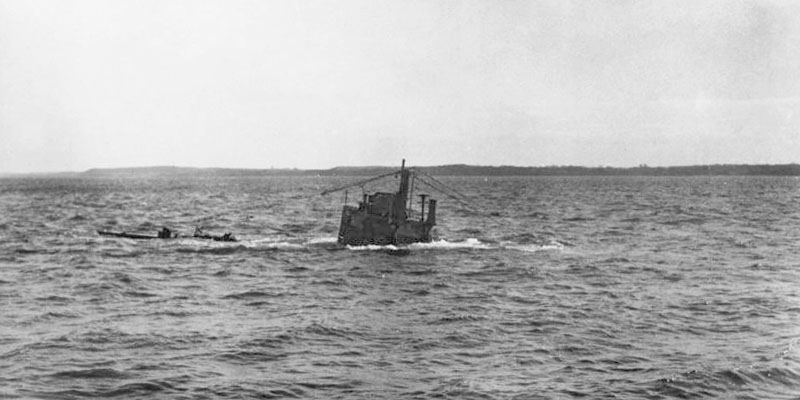
When the conflict began, the submarines had not yet been used as weapons of war. The superiority of the British in the sea forced the German fleet to try this new type of war.
British naval block and its impact on the hunger of the German population made Germany's military controls will trust the underwater war as the best means of retaliation. However, on May 7, 1915, A German submarine sank the British transatlantic RMS Lusitania in which 1200 crew and passengers died, including 128 American citizens. The United States government, which was at that time a neutral country, protested vigorously and the German chancellor chose to moderate attacks.
The German military did not agree with the moderation of the Chancellor and asked to start an underwater war without restrictions. Finally, On February 1, 1917, Germany declared the total underwater war . The first months were very harmful to the ships that went and went to England and France, with around 540,000 sunk tons in February, almost 600,000 in March and 875,000 in April.
However, the final result was totally contrary to what the Germans expected. As of April, the British organized convoys systems (some war ships escort the merchant ships) and significantly reduced losses. Besides, The underwater war seriously harmed US producers and exporters which precipitated the entrance to war from the United States in April 1917.
The Battle of Caporetto (1917)
The Germans They took advantage of the situation caused in the eastern front by the Russian revolution and They helped the Austrohungary troops in an attack against the Italian lines In October 1917. The Italian troops, taken by surprise, backed up until they managed to restore the lines around the Piave River, north of Venice, on November 9.
The Italian army lost a lot of weapons and other military materials, Almost 300,000 men were made prisoners and more than 10,000 lost their lives . The Caporetto disaster led to the resignation of the president of the Council of Ministers of Italy and his replacement for Vittorio Emanuele Orlando, who dismissed Luigi Cardona at the head of the Italian troops and appointed General Armando Díaz in his place.
The Battle of Vittorio-Veneto (1918)
In need of a victory to be able to negotiate in the imminent peace negotiations, the Prime Minister of Italy, Vittorio Emanuele Orlando, pressed the commander in chief of the Italian army, Armando Díaz, To attack the weakened Austrohungary lines In northern Italy.
The end of the war and Diaz's army approached, with the support of French and British troops, The attack began on October 23, 1918. The Austrohungal Front collapsed And, by November 2, the Italians had already made more than 300,000 prisoners.
On November 3 Austria-Hungría signed the armistice In Villa Giusti, Padua. A few days later, on November 11, Germany signed the armistice with the military authorities of France and the United Kingdom and concluded the war.
- See also: Figures and Statistics from World War I
Letter from an English soldier from the front
The English noncommissioned officer DL Rowlands served in the 15th Light Infantry Battalion of Durham. In February 1918 he sent a letter to his future wife from France. In it he told him details of his participation in the battle of Broodseinde in October 1917, in the context of the battle of Passchendaele, in Belgium. The letter describes the fatigue and moral low of the soldiers in the front.
Dl Rowlands letter to his future wife
February 5, 1918
“France, at night.
My love,
Now, if there are no problems, you will know everything about what is happening here. I know you'll get a big surprise when this letter comes to you. I hope I arrive without setbacks. If any authority saw it! (…)
Maybe you would like to know how the mood of men is here. Well, the truth is that (and as I told you before, they would shoot me if someone of importance would find out about this letter) everyone is totally fed up and none has anything known as patriotism. Nobody cares about a radish if Germany has Alsace, Belgium or France. The only thing everyone wants is to end this once and go home. This is honestly the truth, and any man who has been out in recent months will tell you the same.
In fact, and this is not an exaggeration, the greatest hope of the vast majority of men is that riots and protests at home force the government to end anyway. Now you know the real state of the situation (…).
I can add that I have also lost practically all the patriotism that I had left, I only have to think of all of you who are there, you who love me and that trust me to do my part of the work that is necessary for your safety and freedom. That is the only thing that keeps me standing and allows me to endure it. As for religion, that God forgives us, does not occupy one among a million of all the thoughts that occupy the minds of men every hour …
God bless you love and all those who love and love me, because without their love and trust it would faint and fail. But do not worry my heart because I will continue until the end, whether sweet or bitter (…).“
Laurie
- World War I peace treaties
- Consequences of World War I
- End of World War I
- Interwar period
References
- Letter from DL Rowlands, February 5, 1918, in: BBC News. http://news.bbc.co.uk/
- Hart, P. (2014). The Great War 1914-1918. Military history of World War I. Criticism.
- Morrow, JH (2004). The Great War: An Imperial History. Routledge.
- Showalter, from & Royde-Smith, JG (2023). World War I. Britannica Encyclopedia. https://www.britannica.com/
- Stevenson, D. (2013). 1914-1918. History of World War I. Debate.
- Stone, N. (2013). Brief History of World War I. Ariel.


