
We explained how many people fought and how many died in World War I. In addition, the economic costs and labor incorporation of women.
What was World War I?
World War I was a military conflict that faced the central empires (Germany, Austria-Hungary, Turkey and Bulgaria) with the entertainment or allies (headed by the United Kingdom, France, Russia, Italy and the United States). It began at the end of July 1914 and ended in November 1918 with the victory of the entente.
World War I mobilized a huge amount of troops and had an unprecedented human cost: caused the death of almost nine million combatants and seven million civilians . In addition, he left a balance of twenty million injured and mutilated.
Military effort also implied a great economic cost and the destruction of areas in countries such as France and Belgium led to the demand for many resources for reconstruction during the postwar period.

- See also: Chronology of World War I
The human cost of World War I
The human losses during the four years that the First World War lasted reached a number that was only surpassed by World War II (1939-1945). Millions of men were mobilized From the first year of the conflict and, as war progressed and large casualties were produced, the number grew.
The countries that mobilized the most combatants throughout the war were Russia (twelve million), Germany (eleven million), the United Kingdom (almost nine million) and France (a little more than eight million). The total number between the entente and the central empires was sixty -five million mobilized people .
| Military troops 1914-1918 | ||
|---|---|---|
| Country countries | Effective The armies and The reserve (1914) | Forces mobilized 1914-1918 |
| Russia | 5,971,000 | 12,000,000 |
| France | 4,017,000 | 8,410,000 |
| Great Britain | 975,000 | 8,904,467 |
| Italy | 1,251,000 | 5,615,000 |
| USA | 200,000 | 4,355,000 |
| Japan | 800,000 | 800,000 |
| Romania | 290,000 | 750,000 |
| Serbia | 200,000 | 707,343 |
| Belgium | 117,000 | 267,000 |
| Greece | 230,000 | 230,000 |
| Portugal | 40,000 | 100,000 |
| Montenegro | 50,000 | 50,000 |
| Central Empires countries | Armies and The reserve (1914) | Mobilized forces 1914-1918 |
| Germany | 4,500,000 | 11,000,000 |
| Austria-Hungary | 3,000,000 | 7,800,000 |
| Türkiye | 210,000 | 2,850,000 |
| Bulgaria | 280,000 | 1,200,000 |
Total dead were almost nine million combatants and seven million civilians , to those who joined Twenty million injured and mutilated and a significant fall in the birth rate. The main countries affected by deaths during the war were Russia, France, Germany and Austria-Hungary.
- See also: Dead in World War I
The economic cost of World War I
The economic cost of World War I was also very high. To deal with the mobilization and supply of troops, as well as the production of weapons and other assets for war, enormous resources had to be consumed.
The total military spending of the war lasted calculated in dollars of 1913, gave the approximate sum of 82.4 billion dollars of which 57.7 billion corresponded to the entente and 24.7 billion to the central empires.
An alternative calculation, based on dollars at current prices, gives the figure of 208.5 billion total dollars (147,000 million of the entente and 61.5 billion of the central empires).
| The economic cost of World War I | |
|---|---|
| Countries | Expenses in billions of dollars (at 1913 prices) |
| Entente | 57.7 |
| British empire | 23.0 |
| USA | 17.1 |
| France | 9.3 |
| Russia | 5.4 |
| Italy | 3.2 |
| Other allies (whose expenses were compensated for loans) | -0.3 |
| Empires Central | 24.7 |
| Germany | 19.9 |
| Austria-Hungary | 4.7 |
| Türkiye and Bulgaria | 0.1 |
The composition of spending on each side reveals that Most of the cost of the central empires was facing Germany And, on the side of the entente, the United Kingdom and the United States . On the other hand, at the end of the war France and Belgium were especially affected by the destruction of much of their territory.
The industry before and after World War I
World War I exploded at a time of technical innovations and economic expansion That was the result of the second industrial revolution . This resulted in the use of new technologies in the war and the orientation of most economic and human resources towards military activity.
After an interruption of economic and demographic growth during the war, in the twenties a recovery of the economy of the powers began (which in turn stopped when the great depression of the thirties began). The United States consolidated itself as an industrial power that overcame the United Kingdom and New York became the new financial capital of the world.
| Levels of industrialization per capita 1880-1938 (Relating to the United Kingdom in 1900 = 100) | |||||
|---|---|---|---|---|---|
| Countries | 1880 | 1900 | 1913 | 1928 | 1938 |
| United Kingdom | 87 | 100 | 115 | 122 | 157 |
| USA | 38 | 69 | 126 | 182 | 167 |
| France | 28 | 39 | 59 | 82 | 73 |
| Germany | 25 | 52 | 85 | 128 | 144 |
| Italy | 12 | 17 | 26 | 44 | 61 |
| Austria-Hungary | 15 | 23 | 32 | – | – |
| Russia | 10 | 15 | 20 | 20 | 38 |
| Japan | 9 | 12 | 20 | 30 | 51 |
| Percentage participation of great powers In world industrial production 1880-1938 | |||||
|---|---|---|---|---|---|
| Countries | 1880 | 1900 | 1913 | 1928 | 1938 |
| United Kingdom | 22.9 | 18.5 | 13.6 | 9.9 | 10.7 |
| USA | 14.7 | 23.6 | 32.0 | 39.3 | 31.4 |
| Germany | 8.5 | 13.2 | 14.8 | 11.6 | 12.7 |
| France | 7.8 | 6.8 | 6.1 | 6.0 | 4.4 |
| Russia | 7.6 | 8.8 | 8.2 | 5.3 | 9.0 |
| Austria-Hungary | 4.4 | 4.7 | 4.4 | – | – |
| Italy | 2.5 | 2.5 | 2.4 | 2.7 | 2.8 |
| Total industrial potential of the powers in Relative perspective 1880-1938 (Relating to the United Kingdom in 1900 = 100) | |||||
|---|---|---|---|---|---|
| Countries | 1880 | 1900 | 1913 | 1928 | 1938 |
| United Kingdom | 73.3 | 100 | 127.2 | 135 | 181 |
| USA | 46.9 | 127.8 | 298.1 | 533 | 528 |
| Germany | 27.4 | 71.2 | 137.7 | 158 | 214 |
| France | 25.1 | 36.8 | 57.3 | 82 | 74 |
| Russia | 24.5 | 47.5 | 76.6 | 72 | 152 |
| Austria-Hungary | 14 | 25.6 | 40.7 | – | – |
| Italy | 8.1 | 13.6 | 22.5 | 37 | 46 |
| Japan | 7.6 | 13 | 25.1 | 45 | 88 |
The incorporation of women into work
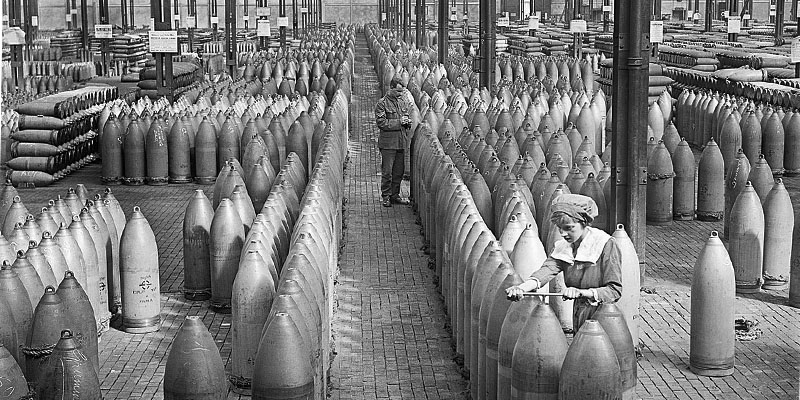
The shipment of millions of men to the warfall increased the labor participation of women in the industry (including ammunition factories) and in other areas, especially in countries such as the United Kingdom and France, although many women also participated in the front, mainly as nurses.
The importance of female contribution during the war helped women achieve rights that were claimed since previous years, such as female suffrage (recognized in 1918 in the United Kingdom to women over 30 years of age with certain conditions and, as of 1928, on equal terms as men).
| The incorporation of women to work in the United Kingdom | ||||||
|---|---|---|---|---|---|---|
| Percentage of women about employee men | Industry % | Transport % | Agriculture % | Trade % | Total Workers % | |
| July 1914 | 26 | 2 | 9 | 27 | 24 | |
| July 1918 | 35 | 12 | 14 | 53 | 37 | |
| July 1920 | 27 | 4 | 10 | 40 | 28 | |
- Consequences of World War I
- World War I battles
- Military Heads of World War
References
- Aldcroft, DH (2003). History of the European economy 1914-2000. Criticism.
- Kennedy, PM (1987). The Rise and Fall of the Great Powers. Random House.
- Showalter, from & Royde-Smith, JG (2023). World War I. Britannica Encyclopedia. https://www.britannica.com/
- Stone, N. (2013). Brief History of World War I. Ariel.
- U-Bat War in World War One. Uboat.net. https://uboat.net/


