We explain what the Bronze Age is, what are its characteristics and stages. In addition, the first civilizations, the end of the period and more.

What is bronze age?
Bronze age is a Prehistory period, understood within the age of metals . It is located between copper age and iron age. It begins with the discovery of bronze, as a metal product of copper alloy with tin. It ends with the appearance of iron as a favorite metal for the manufacture of weapons and tools.
The dating of the age of metals is used in the study of Asian, European and African populations. Chronologically, the Bronze Age It can be located approximately between 3000 and 800 a. C. However, while in some cultures technologies were developed for the work and alloy of metals, in other populations metals did not work, but developed other technological advances. Therefore, metal age terminology should not be used as a measure of historical progress, but as a reference to the development of artisanal work techniques and systems.
On the other hand, during the Bronze Age the first state organizations appeared, with more numerous populations and a more complex and hierarchical social system.

Bronze age characteristics
The Bronze Age was characterized by:
- The discovery of the Metal Foundry .
- The formation of societies of high population density .
- The emergence of the first state organizations .
- The first complex social organization with classes differentiation with the people and the ruling class.
- The increase in war confrontations, with sophisticated armaments .
Bronze age civilizations
The main civilizations that integrated the Bronze Age were:
Mesopotamia
Towards 3000 a. C., The Sumerians, who inhabited Asian Mesopotamia, were the first to use bronze for the manufacture of tools, weapons and utensils. In parallel to this technological development, the Sumerians developed other advances (such as channeling for irrigation waters) that allowed them to intensify their agricultural production and generate a productive economy of surpluses.
This process favored social differentiation and stratification, the appearance of privileged social groups and the concentration of power. The settlements became urban centers with greater magnitude with constructions dedicated to specific tasks of artisanal production, religious worship and government.
Are They were the first state organizations with a centralized power that monopolized production surpluses, and a privileged social group that controlled central power. Another fundamental invention linked to the appearance of the State was the cuneiform deed, mainly used to register the collection of surpluses and the administration of government resources.
In this period, the Sumerian cities of Uruk, the Akkadian Empire and the Kingdom of Babylon stood out.
Africa
In North Africa, The ancient Egyptians began using bronze from 3100 a. C. However, the shortage of metal in the region caused the stone to be replaced as a fundamental material in the manufacture of tools and other artisanal production objects.
Shortly after the discovery of bronze, Egyptian society crossed the same processes of intensification of agricultural production social stratification and centralization of power that Sumerian societies. Towards 3000 a. C., the high and bass Egypt unified under the reign of the first pharaonic dynasty.
Far East
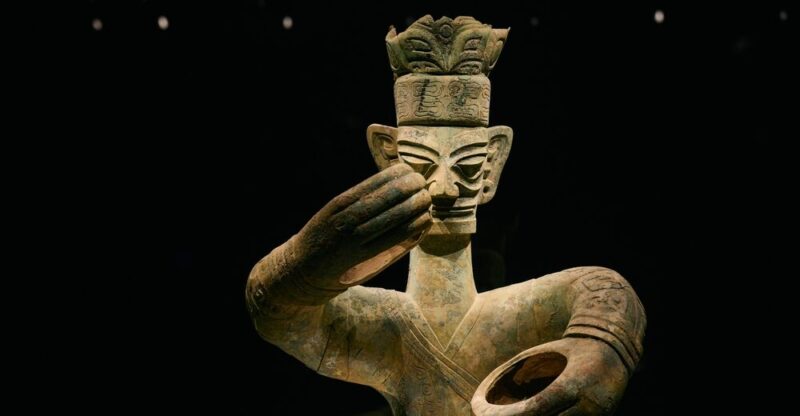
Bronze age In China it developed from 1700 a. C. and lasts for several dynasties for 1500 years. It is believed that it could have been earlier, but academics still discuss how to interpret archaeological evidence.
Bronze in China It was used to create different types of pieces of domestic, war, ritual and ceremonial use . The cauldries are especially recognized ding of three legs, which originally had domestic use and, over time, became symbols of state power.
Europe
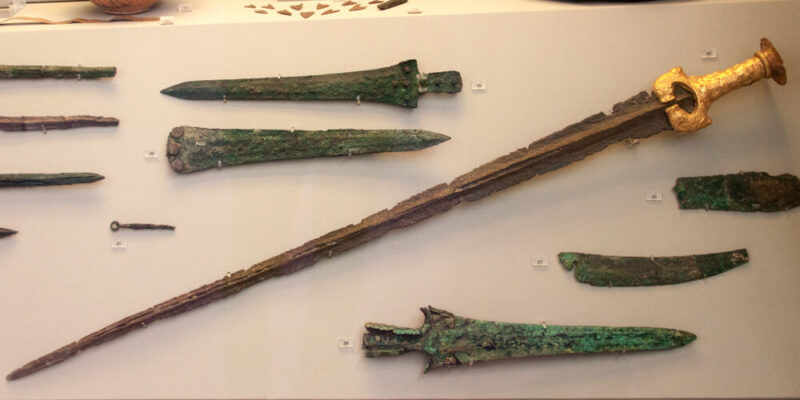
In the Aegean region, the prehellenic populations (predecessors of the Greek civilization) inhabited the cycled islands, the coastal areas of continental Greece and the island of Crete. With the development of bronze technology, naval construction was improved and, therefore, the speed and effectiveness of vessel trips.
Due to the geographical nature of the region, this turned out to be a fundamental advance. The ease of navigation allowed the colonization of numerous islands and coastal areas and the foundation of commercial enclaves.
This process led to the enrichment of some commercial groups that, over time, they managed to impose themselves and obtain privileges within their communities. The emergence of small independent cities-states brought the social differentiation, the centralization of political power and the appropriation of production surpluses (of the peasants of the agricultural communities).
Among the most important civilizations in the field of Aegean during the Bronze Age, the Minoan Civilization (2000-1600 BC) and the Cretan civilization (1600-1200 BC) stood out.
In the central area of Europe, bronze was introduced to 1800 a. C. The main cultures of the region were the UNETETIC GRUPS (in the current Czech Republic, Germany and Poland), the Otomani (in the Balkan Region) and, around 1600 BC. C., the culture of the tumulos. These populations resided in villages, often walled with wood.
The numerous and valuable resources of the region exploited, such as tin mines, copper and gold. They were skilled merchants and They developed exchange networks that reached the Aegean and the Iberian Peninsula . They used the horse and the car, which gave them great mobility and warlike superiority. However, they did not constitute large political units.

References
- Eiraa, JJ (2003). NOTITIONS OF GENERAL PREHISTORY. Grupo Planeta (GBS).
- Food, MH, & Steve, MJ (eds.). (1989). Prehistory (Vol. 1). 21st century of Spain editors.
- “Bronze Age” in History
- “Bronze Age” in Britannica