
We explain how the end of the Cold War was. In addition, the historical context, key events and world repercussions.
What was the cold war?
The cold war was the process of political, economic and cultural confrontation between two blocks, led by the United States (western or capitalist block) and the Soviet Union (oriental or communist bloc) .
The Cold War, which included military episodes in areas of influence of both powers but never directly faced them on a battlefield, took place between the end of World War II in 1945 and the dissolution of the Eastern bloc and the Soviet Union (USSR) in 1991.
The 1989 revolutions against communist domain in Eastern Europe were a historical event of multiple resonance. On the one hand, they constituted The collapse of the communist systems built after 1945 . On the other hand, they meant the loss of the area of influence that the USSR had built after her victory against Nazism (and that many called “Soviet empire”).
The Cold War, the confrontation that had marked international relations since the end of World War II, ended in a way that no one had dared to predict a few years before: by the collapse and disintegration of one of the contestants (the Soviet Union). The end of the Cold War and the disappearance of the Soviet Union were two parallel phenomena that radically changed the world.

Key points
- The Cold War was a period of political, economic and cultural confrontation between two groups of countries led by the United States and the Soviet Union respectively.
- The Cold War process occurred between the end of World War II (1945) and the fall of the Soviet Union (1991).
- During the Cold War in Central and Eastern Europe (territory of the communist bloc) there were transitions to democratic governments, economic crises and a weakening of the influence of the Soviet Union after the assumption of the power of Mikhail Gorbachev.
- The main events that marked its cessation were: the Summit of Malta (1989) between George Bush and Mikhail Gorbachev, the fall of the Berlin wall (1989), the new international relations that it represented, the letter of Paris (1990), and the dissolution of the Soviet Union (1991).
The historical context
Mijaíl Gorbachev reforms in the USSR
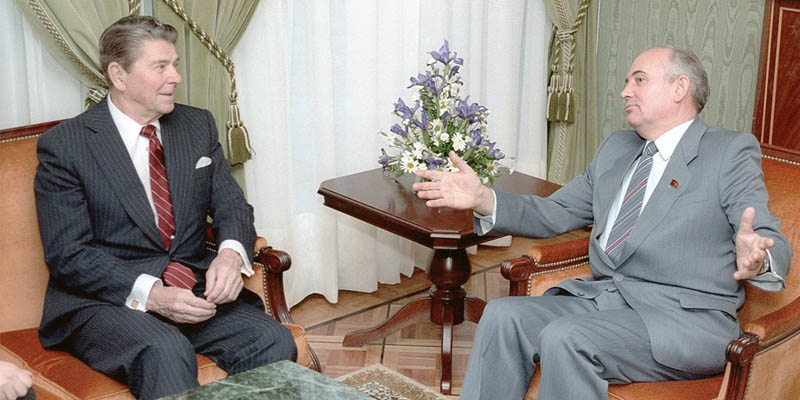
The cold war ended due to progressive collapse of the Soviet Union and the communist bloc from the reforms of Mikhail Gorbachev who assumed the position of general secretary of the Communist Party of the Soviet Union (PCUS) in 1985.
The situation faced by the new Kremlin leader was difficult: after long years of stagnation, the economy was on the edge of collapse and Soviet society was immersed in a true moral crisis, characterized by the lack of ideological commitment and general skepticism.
The challenge of The Strategic Defense Initiative From the president of the United States, Ronald Reagan had made aware of the Soviet leaders of their limitations to deal with the United States technological and military competition. The USSR urgently needed to reduce its military spending (That, according to the sources, he ranged between 16 and 28 % of his budget) and directing his resources to alleviate the multiple deficiencies of the Soviet economy. For Gorbachev, the need for an approach to the United States was evident.
The reform in foreign policy came before the Perestroika (economic restructuring) or Glasnost (transparency) in internal politics. In October 1985, Gorbachev began visiting various Western capitals. In his first meeting with President Reagan in Geneva, in November 1985, the Soviet leader raised the need for distension and reduction of nuclear armaments.
The “new political thought” of Mikhail Gorbachev
Gorbachev proclaimed in the XXVII Congress of the PCUS in 1986, through its international politics, Anatoli Dobrinin, which he called a “New political thought” (Novy MyShlenie): The New World was characterized by the “global interdependence”, hereinafter You had to forget the logic of the cold war and seek cooperation and consensus in the direction of international relations.
The agreements with the US government for the reduction of weapons followed during the following years. In addition, Gorbachev announced in December 1988 before the United Nations a unilateral reduction of 500,000 men in the Soviet Armed Forces and the withdrawal of troops and combat cars from Eastern Europe.
Simultaneously, The Soviet Directorate initiated a policy of separating its commitments with its allies Throughout the world: he gradually communicated to his allies (such as the Cuban, Nicaraguan, Ethiopian regimes, among others) the end of their military and economic support. He also promised to remove his troops from Afghanistan, which began to make effective in February 1989.
Throughout 1989, revolutions and transitions to democratic, parliamentary and market economies that disintegrating the communist bloc, and As of 1990, the disintegration of the Soviet Union itself began, which took place when Gorbachev resigned on December 25, 1991 and the USSR ceased to exist. Shortly before, the Warsaw Pact, the Military Alliance that had committed the Soviet Union and the countries of the Eastern Block since 1955.
The events that precipitated the end of the Cold War
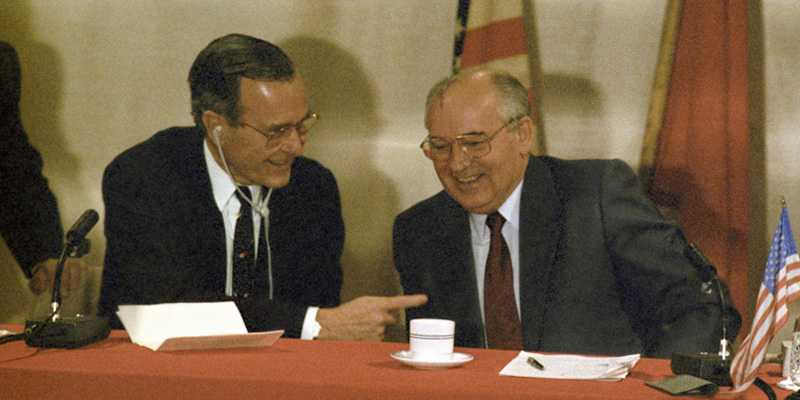
Historians do not agree on the exact moment in which the Cold War concluded. The main diplomatic events that marked the 1989, 1990 and 1991 were:
- The Malta Summit Among the US president George Bush and Soviet leader Gorbachev, who for many historians marked the end of the cold war. Both leaders gathered on the Maximum Gorki ship anchored on the coast of Malta on December 2 and 3, 1989. A few weeks after the fall of the Berlin Wall, which had happened on November 9, the two leaders gathered to comment on the vertiginous changes that Europe was living and officially proclaimed the beginning of a “new era in international relations” as well as the end of the tensions they had defined to the cold war. Bush declared his intention to help the USSR to integrate into the international community, and asked the American businessmen to “help Mikhail Gorbachev.” The Soviet leader solemnly proclaimed that “the world ended a time of cold war (…) and began a prolonged peace period.”
- Other researchers point out that the end of the conflict took place on November 21, 1990, when the United States, the USSR and other participating thirty states at the Conference for Security and Cooperation in Europe They signed the Paris letter a document that had the main purpose of international relations after the end of the Cold War. The letter included a non -aggression pact between NATO and the Warsaw Pact. After signing the document, President Bush said: “We have closed a chapter of history. The Cold War is over.”
- Only two days before the Paris letter had been signed The Treaty on Conventional Armed Forces in Europe (November 19, 1990), which supposed a strong reduction of troops and non -nuclear weapons in the European continent. After establishing negotiations in Vienna in March 1989, the agreement was reached that both superpowers had to reduce their troops in Europe to 195,000 men each. It started from the presence of 600,000 Soviet soldiers and 350,000 Americans.
- On January 16, 1991, an international coalition led by the United States began its military campaign to evict Iraqi troops who had invaded Kuwait. Soviet support for UN sanctions against Iraq, which preceded the trigger for the Gulf War was agreed at the Summit of Helsinki, held on September 9, 1990 between Bush and Gorbachov. This support was a palpable example of the end of American antagonism and supremacy.
- On July 1, 1991, after the revolutions of 1989 in Central and Eastern Europe, and in the process of decomposing of the Soviet State, the treaty of friendship, cooperation and mutual assistance signed in Warsaw in 1955, better known as Warsaw pact, officially ceased to exist . NATO remained as the only great military alliance in the world.
- Finally, on July 31, 1991, Bush and Gorbachev signed in Moscow the Start I Treaty of Strategic Weapons Reduction . This agreement was quickly exceeded the following year, on June 16, 1992, for the elaboration of the Start II Treaty and its signature, on January 3, 1993, by Bush and the new Russian leader, Boris Yeltsin. The two former contestants agreed important reductions in their nuclear arsenals.
In a very fast process, The Soviet Union and the United States ended the long confrontation that had started after the end of World War II. The order established in the Yalta conference (1945) collapsed in a few months, before the stunned look of the world.
On December 25, 1991, Gorbachev resigned and the Soviet Union ceased to exist, replaced by 15 independent states. The president of the United States, Bush, referred to the new situation as a “new world order.”
The end of the Cold War and its repercussions on the world

The collapse of the USSR left the United States as the only superpower world . The victory in the Cold War erased the memories of the defeat in Vietnam. From now on, Washington was able to play the role of “World Gendarme” without fear of the concurrence of another superpower. In addition, the end of the Cold War and the new world situation had important repercussions in various parts of the world.
Repercussions in the Middle East
The Gulf War (1990-1991)
When Saddam Husseín, president of Iraq, The small and rich state of Kuwait invaded on August 2, 1990 with the aim of alleviating the enormous losses caused by the war that had faced Iraq with Iran between 1980 and 1988, it did not take into account the new situation that had been created with the end of the cold war.
Following the proposals of the United States, the UN condemned the aggression decided to apply economic sanctions to Iraq and finally authorized military intervention. The Soviet Union, a traditional ally of Iraq, did not have enough strength to veto in the UN Security Council the guidelines of American politics.
So, US President George Bush was able to articulate a great international coalition . In addition to their traditional allies in NATO, the new regimes in Eastern Europe, Egypt and most Arab countries and the new industrialized countries of Asia were added or supported to the coalition. All these nations sought the alliance and friendship with superpower.
The outcome of the Gulf War was predictable. Saddam Hussein could barely launch some Scud missiles on Israel, many of them intercepted by the American antimile system Patriot (the intention was for Israel to enter the war and force the exit of the Arab countries of the coalition, but this strategy was frustrated). After an intense bombardment initiated on January 15, 1991, when the ultimatum launched to Iraq for the UN concluded, The coalition troops greatly released the Kuwaiti territory .
To the surprise of many, US troops did not continue their way to Baghdad (the capital of Iraq), and allowed Saddam Hussein to continue in power. On February 28, 1991, the fire was agreed although conflicts with Iraq resumed in the following years.
The Arab-Israeli peace process
After the outbreak of The intifada (Palestinian revolt against the Israeli occupation) in 1987 In Gaza and the West Bank, the Palestine Liberation Organization (OLP) and its leader, Yasser Arafat, managed to consolidate in the direction of Palestinian resistance.
In that context, the Palestinian National Council in Algiers met in 1988 and agreed to proclaim the independence of the State of Palestine, by accepting the UN November 1947 agreement that decided the Palestine partition in two states (which implied, in turn, the recognition of the state of Israel).
Gorbachev had received Arafat in April 1988 and asked him to take into consideration “the interests of Israel's security.” The end of the cold war facilitated that United States and the Soviet Union will convene a conference on peace in the Middle East in Madrid in October 1991.
In the capital of Spain a difficult peace process was opened based on the principle of “peace for territories.” After arduous secret negotiations in Oslo, in September 1993, the “declaration of principles on the provisions related to a provisional autonomous government” was signed in Washington that He began a peace process that ended up failing .
Repercussions in Europe
In Europe, the end of the Cold War basically caused two opposing reactions:
- In Western Europe the integration processes were accentuated . After the signing of the Unique Act in 1986, the twelve associated countries in the European Economic Community signed The 1992 Maastricht Treaty, which gave birth to the European Union (1993). Three years later, the European Union was extended through the entry of Sweden, Finland and Austria.
- In central and eastern Europe, the collapse of communist systems and the USSR opened a period of political disintegration . In some cases it was a peaceful process, such as the “friendly divorce” between the Czech Republic and Slovakia (in what had been Czechoslovakia) in 1993; In the case of Yugoslavia, a heartbreaking process was opened that introduced the war in Europe again after a period of peace initiated in 1945.
- The fall of the communist regime Organized by Marshal Tito aroused nationalist clashes Among the peoples of the Yugoslava Federation. The ultra -nationalist policy of the communist leader Serbio Slobodan Milosevic produced the reaction of the other Yugoslav republics. In 1991, Slovenia and Croatia declared their independence, which caused a bloody war between Serbs and Croats. The situation became even more dramatic when, a year later, the war moved to neighboring Bosnia-Herzegovina. The ethnic-religious conflict between Orthodox Serbs, Catholic Croats and Muslim Bosnians made radical nationalism and “ethnic cleaning” again in Europe.
Repercussions in other regions of the world
The world situation in the early 1990s was clearly contradictory. On the one hand, conflicts such as Arab-Israeli, Lebanon or Cambodia advances in respect for human rights, as the end of the regime of Apartheid In South Africa in 1990-1991 and the call in that country of the first democratic and restrictions based on racial arguments in 1994.
On the other hand, Located conflicts, such as the brutal war between the Hutus and Tutsis communities in Rwanda and Burundi (1990-1994), made the difficulties patent of the international community to establish a “new world order” based on respect for human rights, international solidarity and democratic values that organisms such as the UN claimed to defend.
As for Latin America, the end of the Cold War and the dissolution of the Soviet Union opened an especially critical period (known as “special period”) for the Cuban communist regime whose economy depended largely on its links with the Soviet block. This generated the shortage of resources and a stricter ration policy, which in turn caused protests of the population and led to government promotion of foreign investment in some areas of the economy, such as tourism.
Continue with:
References
- Britannica, Encyclopaedia (2022). Cold War. Britannica Encyclopedia. https://www.britannica.com/
- Britannica, Encyclopaedia (2022). Collapse of the Soviet Union. Britannica Encyclopedia. https://www.britannica.com/
- Powaski, Re (2000). The Cold War: the United States and the Soviet Union, 1917-1991. Criticism.
- Veiga, F., Da Cal, E. & Duarte, A. (2006). Simulated peace. A story of the Cold War. Alliance.


