We explain what feudalism is and how society was divided at that time. In addition, what was based on its economy and its characteristics.
What was feudalism?
Feudalism was a social system that emerged in the Franco kingdom in the High Middle Ages and extended through Western Europe during the middle of the Middle Ages (between the XI and XIII centuries). From an economic point of view, it was a land tenure regime that favored the rural nobility and stimulated servitude. From a political point of view, it was a dispersion of power in favor of feudal lords with local and regional authority.
Feudal relationships were contracts of mutual obligations between two free men: a man and a vassal. The Lord granted protection and land (called “fiefs”) to a vassal in exchange for fidelity and military assistance (or other benefits). The kings had their own vassals that, at the same time, could be lords of other vassals, and thus a pyramid of land and obligations that involved a good part of society was forming.
In the feudal system Peasants were especially important because the socioeconomic base was rural. On the one hand, the servants were tied to a land that they did not possess and had to pay income to a man. A land assigned as a fief always included the servants who worked it. On the other hand, the free peasants had their own lands but could be obliged to pay fees or taxes to a man with jurisdictional power.
The term “feudalism” is also employed by some historians to characterize other historical experiences like China during the Zhou dynasty, Japan in the times of shogunate, and parts of Eastern Europe in various stages of history.
Historical context of feudalism
An antecedent of feudalism was the colonato regime in the Roman Empire. In this regime Large land owners installed settlers (liberated slaves or peasants) that they had to work for their own livelihood and to pay income to their lord, which they obtained, in return, protection.
After the fall of the Roman Empire in the 5th century, Western Europe was divided into several smaller political units until the conformation of the brief Carolingian empire. This implemented a system of rewards to loyal nobles that supposed land delivery in exchange for services (especially military).
After the disintegration of the Carolingian empire in the ninth century, Several areas of Western Europe were attacked by Magiares, Muslims and Vikings . The defense required speed and fell to the local lords who had resources to build fortifications and gather combat forces without waiting for the arrival of real troops.
This encouraged a political fragmentation system that gave power to feudal lords and gave its form to the full Middle Ages. Even so, from the end of the eleventh century some kings, Dukes and Condes began a process of concentration of political power that placed them in a position of greater authority in their territories, such as King Louis VI of France, Count Ramón Berenguer I of Barcelona and Duke Guillermo II of Normandy that reached the throne of England.
The feudal system was losing prominence from the fourteenth century when epidemics, peasant revolts and the growing impulse of the urban bourgeoisie decreased the power of the nobility and opened the path to the emergence of centralized monarchies.
The feudal society
Social estates

The feudal society was divided into three well -differentiated estates:
- Nobility . The nobles had large extensions of land, in general, received as remuneration to their military efforts or other services (although in practice they could also be inherited). They were organized on lineages and maintained vassalage links with other feudal lords or with the king. According to their noble titles and its location in the social structure, they could belong to the high nobility (Dukes, Counts and Marquises) or the low nobility (Biscay, barons, gentlemen, nobles, among others).
- Clergy . Ecclesiastical staff, whose maximum authority was the Pope based in Rome, dealt with religious affairs, dominated the human behavior of the time. Ecclesiastics could belong to the secular clergy that resided in churches and cathedrals, or the regular clergy that followed the rule of a religious order and resided in convents or monasteries. But they also used to have privileges of feudal lords.
- Workers . In the conception of the time, this estate was integrated by the servants, but some historians include different types of workers who will later form the so -called “plain state.” The servants were the lowest stratum of feudal society, responsible for cultivating the land and making them produce. They were not slaves but were tied for life to their lord’s land, whom they had to pay an income in kind and sometimes other benefits. His condition was hereditary. Free farmers cultivated their own lands but also had to pay taxes or other obligations to the Lord who had jurisdiction over a territory (generally called “manor”). The artisans and merchants lived in the cities and, although they were related to the other social sectors, they remained outside the feudal regime.
The Church and the nobles They justified this order arguing that each estate had a function determined by God : Pray (clergy), fight (nobility) and work (servants and peasants).
The highest authority in a kingdom was the king or emperor but in practice this also depended on vassalage relationships with other nobles. The feudal lords used to have more factual power than the king within the limits of their own lands.
The vassalage

One of the most important institutions of feudalism was the vassalage. This consisted of a contract of Mutual obligations between two free men: the “Lord” and the “vassal” . The vassalage was a commitment of fidelity and service by the vassal (mainly in military, although it could also be a payment) and obligations of protection or maintenance by the Lord.
In this way, the Lord granted his “fief” vassals, that is, land (with the servants who occupied them) on which the vassals went on to have usufruct rights. For its part, The vassals were committed to assisting their lord every time he summoned them . The gentlemen were also vassals of a man (noble or king), but they did not always receive a fief in exchange for their service.
The vassalage went through a good part of feudal society. A king could be lord of a noble vassal to whom he gave a fief, and this in turn be lord of other vassals with similar commitments. The vassalage contract between nobles was formalized with an oath ceremony that included the “tribute” and “investiture.” A vassal that did not fulfill his oath incurred in felony and could lose the fief . A man who was missing his duties could foster the rupture of the oath by the vassal and the demand for repair.
In this kind of society, a feudal man with numerous vassals could sometimes acquire more power than the king himself.
The Knights

During the times of feudalism the figure of the gentleman arose, which It became a literary motive already in the singing of medieval deeds And in the 16th -century cavalry novels (parodied in the famous novel by Miguel de Cervantes The ingenious Hidalgo Don Quixote of La Mancha).
The knights were Professional Warrior Jinetes were at the service of a feudal king or lord . Some received a feud in vassalage. In general, before being armed gentlemen had to meet a series of stages, starting as pages and squires, and should be able to acquire their own military equipment (such as sword and armor).
The cavalry was a important military component that offered mobility and attack strength but it also became an ideal of honor and religious devotion. The gentleman had to follow a strict code of conduct. His participation in the Crusades was especially important, and some Catholic religious-military orders, such as the Knights Templars and Teuton Knights, were born in the heat of these war campaigns.
The Catholic Church

One of the most important events of the eleventh century was The schism that separated the Western Catholic Church from the Eastern Orthodox Church (1054) . But in those years, the Catholic Church also experienced a movement of reforms caused by criticisms of corruption already practical such as the sale of ecclesiastical trades and the religious investiture made by laity (according to the principles of the vassalage but against the doctrine of the Church).
Some of these reformist movements came from monasteries such as Cluny’s in France, but the dispute over the appointment of clergy (and even of the Pope) faced the Church with the sacred Germanic Roman Empire in the so -called “complaint of the investiture” (between 1075 and 1122). Finally, The agreement was reached that the laity could not invest clergy or choose the Supreme Pontiff and that this should be chosen by a Cardinals College. This assured papal supremacy in religious matters.
In feudal society, ecclesiastics (especially bishops and abbots) could enjoy the privileges offered by their position in the feudal order: they possessed land and exploited servants. But they also contributed an ideological justification to the system. According to the Catholic Church, the kings ruled by the grace of God and the rigid prevailing social order, which caused all kinds of conditions to those who did not belong to the privileged estates, emanated from God and should not be questioned.
One of the most important initiatives of the Catholic Church in the years of feudalism was His sponsorship of the Crusades . The first of these military expeditions to the Holy Land was born from a call made by Pope Urban II to all Christianity (which included the kingdoms and nobles of Western Christianity in agreement with the Byzantine Empire) in order to expel the Turkish Selyuk Empire of the “holy places.”
Only the first of these crusades was successful for Christianity but it had important consequences, such as the creation of religious-military orders, the consolidation of religious fervor and the opening of commercial routes through the Mediterranean. The defeats in the following crusades had adverse effects for the Church and other privileged sectors.
Rural economy
The generation of wealth during the years of feudalism came basically from agriculture and livestock, in charge of servants and free peasants.
It was a rural economy that experienced growth between the 11th and XIII centuries Due to the expansion of cultivable lands as a result of rotations and triennial rotation, especially in France, England, Germany and the Netherlands. It was also important to incorporate improvements in the plow and the use of mills.
Income and taxes
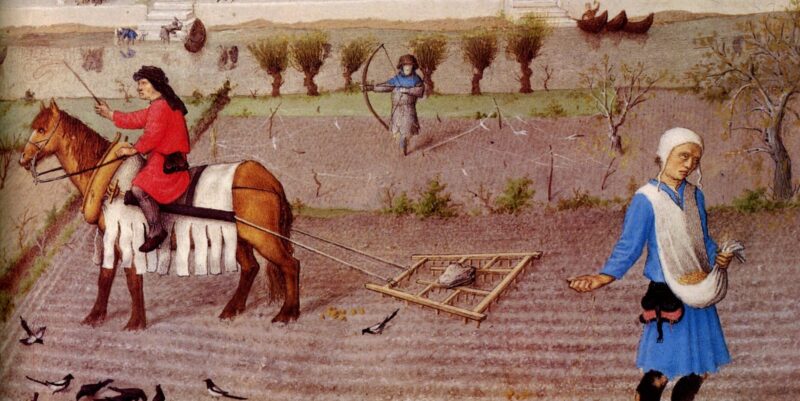
The feudal economy depended on income and taxes. The servants had to pay “in kind” (grain, breeding animals or other agricultural products) the right to live in the lands of the Lord. In some cases they also had to meet benefits as a workforce (for example, in the stately reserve).
Free peasants also had to pay income or taxes, usually in kind. The “Lordship of Ban” gave some lords a jurisdictional power over a territory in which they could give justice and collect rates for the use of bridges, ovens, mills or other facilities in charge. Another kind of tribute was tithe, originally a 10 % contribution of what is produced to the maintenance of the clergy.
Cities and commerce
In the early years of feudal society, trade was very limited and the characteristic urbanism of the Roman Empire had been replaced by an almost absolute ruralization of the economy (with the exception of some Italian cities). However, Cities and commerce lived a resurgence from the end of the 11th century .
Agricultural innovations allowed to generate greater productive surpluses, which were oriented to the purchase of artisanal products, such as fabrics or new tools. These, at the same time, They improved production and expanded agricultural surpluses which allowed to expand the cycle.
These transactions were usually carried out in “Burgos” or cities that inhabited artisans and merchants (known as “bourgeois”). They were located next to castles or at the crossroads of roads and used to be walled. These cities housed markets that used to receive the protection of lords . The commercial impulse also promoted the celebration of seasonal fairs involving exchanges on a larger scale. In these spaces the coin began to circulate more and more and, over time, some merchants and artisans began to offer loans and became the first bankers and financiers.
The inhabitants of the cities They were organized in workshops and guilds by trade and enjoyed a growing autonomy regarding feudal lords. They obtained franchises and other freedoms guaranteed by the king, and in some cities they achieved the formation of an autonomous government with their own municipal ordinances. The most enriched sectors formed an urban patricious. Even so, they had to face conflicts with some feudal lords, which partly explains the use of defensive walls and the subsequent conformation of leagues or cities confederations.
Many cities had prominence on long -range commercial routes. The most important cities were those that were deployed in northern Italy whose merchants competed for the control of Mediterranean trade. Also the pilgrimage routes and the crusades became important commercial circuits.
Military system
The feudal order arose after the disintegration of the Carolingian empire and the attacks of Vikings, Magiares and Muslims. The gentlemen who offered military protection thanks to the vassal services and the construction of castles concentrated power. This military system was also important during frequent wars between kingdoms or lords that took the form of incursions and sieges rather than of bell battles.
This type of war made siege machines and cavalry mobility important. The gentlemen were also important in the crusades that faced Christian combatants with Muslim armies for the domain of the Holy Land.
The war in the years of feudalism was a mode of setting up dynastic or territorial disputes and allowed anyone to obtain economic advantages by occupying the lands of the defeated: its amount of servants (which were tied to the earth) and their possibility of producing food and adding new vassals.
However, war could also be reason for discontent among the peasants who saw their frequently looted land or they had to pay greater taxes to finance the war initiatives of the nobles or kings. Some of the fourteenth -century peasant revolts could be due in part to this fact.
Castles
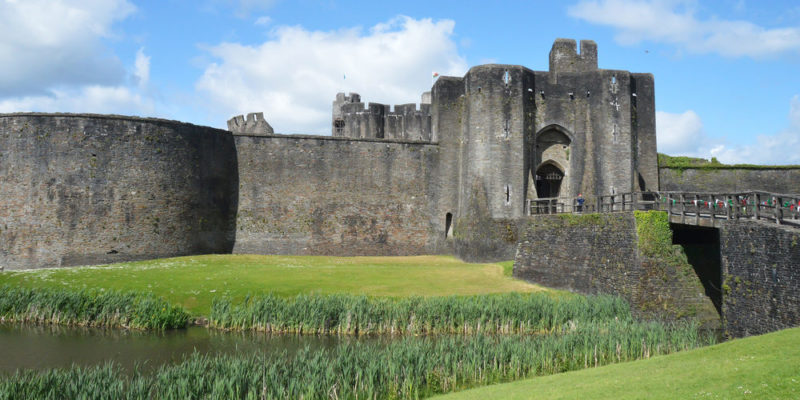
One of the most notable features of the Middle Ages were castles. During the years of feudalism many of These fortified structures that used to be located in strategic sites for example, on high ground. They were sent to build kings or feudal lords and had a mainly defensive function and as a base of military operations.
In case of enemy attack, His high stone walls offered protection to the Lord (called “Castilian”) and his family, and refuge for the peasants of their lordship. They also guaranteed supply in siege situations.
Some of these buildings began to be built during the time of intermittent Vikings, Magiar and Muslim attacks in the ninth and centuries. With the passage of time, construction techniques were perfected.
They were frequently concentric castles, that is, they had a double wall (exterior and interior), and had one or more towers interior courtyards and sometimes a peripheral pit. In addition to their defensive function, the castles served as a permanent or temporary residence of the Lord, who used to receive his vassals there. It was also inhabited men of arms and servers.
During the crusades, castles were built in Asian territory, such as the imposing Crac of hospital knights in the current Syria.
The end of feudalism
The decline of feudalism in Western Europe during the fourteenth century was due to several reasons. Wars, epidemics and migrations to cities decreased the population in the countryside . Labor scarcity stimulated the end of servitude. The nobles, who had to face important peasant revolts, were losing political power.
In wars (especially in the context of the War of the Hundred Years), The kings began to depend more on mercenaries than their vassals while these paid their obligations with currency. Many gentlemen stopped living in their lordships and gave their land in rent to peasants.
Urban bourgeoisies accumulated money and became lenders of kings and princes . This consolidated the big commercial houses that were put at the service of increasingly centralized monarchies, in an increasingly monetized economy.
Finally, although some aspects of feudal society endured for centuries, the stately power inevitably declined.
Continue with:
References
- Bloch, M. (1986). The feudal society. Akal.
- Brown, EAR (2021). Feudalism. Britannica Encyclopedia.
- Duby, G. (1992). The three orders or the imaginary of feudalism. Taurus
- García de Cortázar, Ja & Sesma Muñoz, Ja (2008). Medieval History Manual. Alliance.
- Le Goff, J. (1999). The civilization of the medieval West. Paidós.