
We explain what the Panama Canal, the history of its creation and administration is. In addition, what are its characteristics and importance.
What is the Panama channel?
The Panama Canal is the interoceanic navigation route that crosses the Panama Isthmus in Central America and connects to the Caribbean Sea and the Atlantic Ocean with the Pacific Ocean.
Panama’s channel crosses Panama’s isthmus at its closest point and use a lock system to raise and lower ships to different levels. The locks are filled with water to raise the ships up to 26 meters above sea level, and are then driven to Lake Gatún, the wider point of the channel. After leaving the Gatún Lake, the ships descend through another set of locks until they reach the other side of the channel.
The Panama Canal is crossed in approximately 9 hours, which drastically reduce navigation times since before its construction the ships had to navigate to the Strait of Magallanes, in the southern end of America, to cross from the Atlantic Ocean to the Pacific.
The channel has A length of 77 km . Connect the ports of Balboa, on the coast of the Pacific Ocean, and Cristóbal, in the Caribbean Sea. Inside the channel each lock has a length of 305 meters, a width of 33.5 meters and a depth of 25.9 meters.
The construction of the Panama Canal is considered one of the great world engineering works of the twentieth century.
History of the Panama Canal
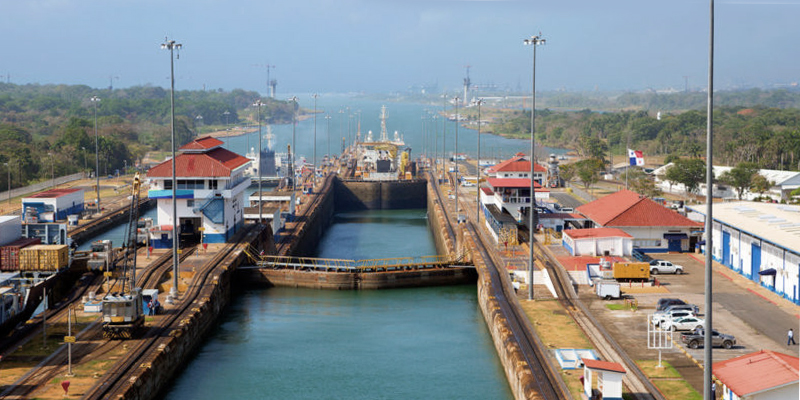
Panama’s isthmus was already used by pre -Columbian native peoples to travel between one ocean and another, and the Spaniards learned that route during the conquest.
The construction of the Panama Canal contemplated different stages and projects, among the main ones are the following:
- 1542 . King Carlos I of Spain proposed the creation of a channel To shorten the travel times between Spain and Peru, but the technological situation of the time and the financial situation of Spain did not allow it. During the nineteenth century the idea of building a channel in Nicaragua arose, but the project was ruled out for political reasons.
- 1839 . The Panama Canal construction project was ceded to a French company for the government of the then Republic of New Granada, but due to the difficulties of the work, the French government and the French company lost interest and renounced the concession shortly after.
- 1879 . The French engineer and diplomat Ferdinand de Lesseps presented a project to build a channel through the Panama Isthmus . He was based on the route that had been drawn to the failed construction of the Panama Railroad in 1850, and the studies and measurements that Alexander von Humboldt had carried out on his trips in the area in the early nineteenth century. In 1879 Ferdinand de Lesseps resumed the project after building the Suez Canal, in Egypt.
- 1881 . The works began in the midst of yellow fever epidemics, the difficulties of the land and the discovery of Business corruption known as the “Panama scandal” .
- 1882 . The works stopped due to an earthquake that shook the isthmus, although Gustav Eiffel, the famous French engineer, had proposed the system of locks as a solution to the injured land.
- 1888 . The financing of the project was interrupted and was completely abandoned.
- 1904 . The United States government resumed the project and, ten years later, the work ended.
- 1914 . The Panama Canal was finally inaugurated.
Expansion of the Panama Canal. In 2006, the Panama Canal Expansion project was formally announced. This project contemplated the construction of broader and deep locks to allow the passage of larger ships. The channels were also expanded and deepened. Thanks to this expansion work, inaugurated in 2016, they can pass through the Panama Barco ships up to three times larger than those that could travel until that moment.
Panama Canal Administration
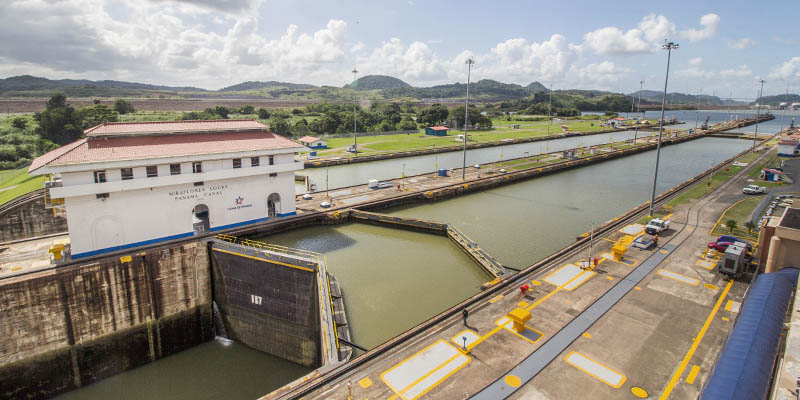
After the opening of the Panama Canal in 1914, its control and administration was assumed by the United States, which kept it until 1977. In that year the governments of The United States and Panama signed Torrijos-Carter treaties so called because at that time the US president was called Jimmy Carter and the Panamanian Omar Torrijos.
Those treaties They established the transfer process of the channel administration to Panama which assumed total control of the operation in 1999. As part of that process the Panama Canal Authority (ACP) in 1997 as the Panama Government -dependent entity in charge of the operation, maintenance and modernization of the channel.
Maritime Traffic on the Panama Canal

According to official data from the Panama Canal Authority, in 2022 a total of 13489 ships traveled through the channel, which represents an average of approximately 37 ships per day. Since its inauguration in 1914 they have traveled more than one million ships along the channel.
Most of the ships that use the Panama Canal are American flag, with 68 % of the total. Secondly, China’s ships are located with 18 %, and in the third and fourth place the Chilean and Japanese flag ships, which together total 11 % of the total.
What does the denomination mean Panamax of the ships?
The Panama Canal was so important in world commercial navigation that Many ships were built with the most appropriate dimensions To travel without problems on the channel. Those ships received the denomination of “Panamax”.
With the passage of time and the increase in international trade, ships began to build larger and larger. It was called “post panamax” to ships that, due to their dimensions, could not cross the channel. After the 2016 expansion most of those “post panamax” ships were able to start using the Panama Canal.
Currently ships are built with the maximum dimensions that can circulate through the expanded channel . They are called “Neo Panamax”, and have maximum dimensions of 366 meters long, a maximum width of 49 meters and a maximum draft of 15 meters. The ships that exceed these dimensions are not suitable to travel through the Panama Canal.
Importance of the Panama Channel
The opening of the Panama Canal had a Significant impact on international maritime trade by providing a much shorter and more efficient route for ships between the Atlantic and Pacific Oceans.
With the opening of the channel Ships could significantly reduce time and shipping costs . This allowed greater efficiency in international maritime trade and an increase in the volume of load that could be transported. In addition, the Panama Canal facilitates trade between Asia, Europe and the east coast of the United States, which makes it one of the world’s main maritime routes.
For the Panamanian economy the channel is a source of income and employment . In 2020 it generated around 2700 million dollars of income to the country, and directly and indirectly used more than 10,000 people. In addition, the channel is a key factor of the country’s economic development since it attracts foreign investment and tourism.
Continue with:
References
- Panama Canal Authority. Pancanal
- Legiscomex (SF). Ships. Legiscomex
- Villa Caro, R (SF). Why are there locks on the Panama Canal? Exponav
- Zanella, L. (2017). The countries that occupy the Panama Canal. T21


