We explain everything about airplanes and how they fly. We also tell you how they were invented and what the first models were.
What is an airplane?
A plane or airplane It is an autonomous flying vehicle, equipped with two fixed wings and a variable number of engines that drive its flight which is intended for transport tasks (of people and/or cargo), military, sports or geographical reconnaissance. Airplanes are the most important means of long-distance transportation in the contemporary world, and their invention made it possible to drastically shorten travel times and thus connect the geography of the world in a way never seen before.
The word “airplane”, the most commonly used to refer to these flying devices in Spanish, has its roots in Latin. avis (“ave”), although in reality it is a loan from French, specifically from planea term coined in 1875 by the French engineer and aviator Clément Ader (1841-1925) and used for the first time in a patent from 1890.
There are different types of airplanes, whose classification takes into account different aspects of the model, for example:
- Planes according to their number of wings . They are classified as monoplanes (one set of wings), biplanes (two sets of wings) and triplanes (three sets of wings).
- Planes according to their propulsion system . They are classified as piston engine airplanes, jet engine airplanes (turbojets, turboprops) and propulsion airplanes (rocket).
- Planes according to their tasks . They are classified into civil aircraft (cargo, passenger transport and other similar functions) and military aircraft (combat, reconnaissance, bombing, troop transport, among others).
Most contemporary aircraft have powerful engines and turbines to travel through the air at hundreds of kilometers per hour. However, there are airplanes that do not have engines, called gliders or sailboats, which are currently used for sporting purposes.
Airplanes play a central role in the modern imagination, and their presence in numerous stories and artistic representations is extremely common, especially in the context of war. It is estimated that there are currently around 200 thousand flights on the planet every day.
invention of airplanes
The invention of airplanes was an important historical milestone for humanity. During pre-modern times, there were several inventors who dreamed or designed machines capable of flight, such as those of Leonardo da Vinci (1452-1519) in the 15th century, but none were successfully built. Finally, In 1783, French brothers Jean-Jacques and Jacques-Étienne Montgolfier designed and built a paper balloon filled with hot air which, being lighter than cold air, floated, aboard which were Francois de Rozier and the Marquis of Arlandes, who became the first human beings to fly.
The challenge of building, however, a heavier-than-air flying vehicle, was achieved when In 1883, the American physicist and inventor John Joseph Montgomery (1858-1911) performed a controlled flight with a glider thus establishing new possibilities that were soon explored by other flight enthusiasts, such as Otto Lilienthal, Percy Pilcher and Octave Chanute.
The first airplane in history was the invention of the French engineer Clément Ader (1841-1925), with which he managed to take off and fly 50 meters in 1890. The feat was repeated in 1892 and 1897, with new designs, on board the last of which he achieved a flight of 300 meters in length.
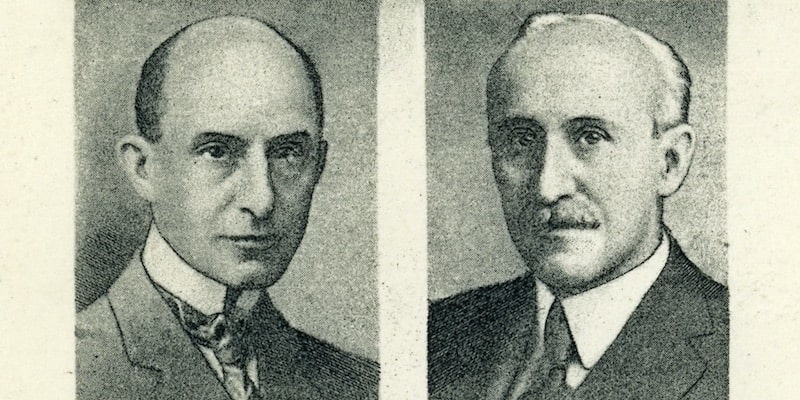
However, Only in 1903 did the brothers Wilbur and Orville Wright achieve the first sustained and controlled flight aboard an airplane powered by an engine . For his part, the Brazilian inventor Santos Dumont (1873-1932) in 1906 became the first human being to take off aboard an airplane powered by an aeronautical engine.
What were the first airplanes?
The first airplanes themselves, that is, autonomous and self-propelled, began to exist at the end of the 19th century, thanks to advances in aerodynamics and successful flight experiences aboard hot air balloons and gliders (unpowered airplanes). These first airplane models were the following:
- The monoplane (1884) . The first monoplane aircraft in history was the invention of the Russian Aleksandr Mozhaiski, and it operated with a steam engine that allowed it a brief flight of between 20 and 30 meters.
- He Éole (1890) . Creation of Clément Ader, this first aircraft to achieve a flight of 50 meters operated with a steam engine, and was the precursor of two other models of his invention, the third of which, plane IIIwas never able to take off. The first flight of Éole It is considered the starting point of modern aviation.
- The Aerodrome (1896) . Work of the American Samuel Pierpont Langley, this prototype aircraft Aerodrome 5 It traveled almost a thousand meters at a speed of about 40 km/h, although without a crew, and inspired new and more successful versions, such as the Aerodrome A, whose improved versions would lead Glenn Hammond Curtiss to take flight in 1910.
- The Flyer (1903) . The famous Wright brothers' glider took flight at about 48 km/h, in several successful attempts. It was a biplane aircraft, which initially required a catapult to take off, until in 1905 it managed to do so under its own power. In 1910, the most recent models of the Flyer achieved the first commercial flight in history, traveling 100 kilometers in one hour and two minutes, at a record speed of 97 km/h.
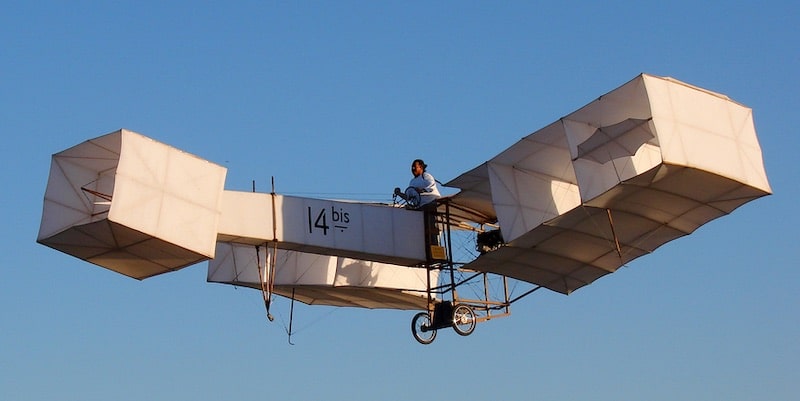
- He 14-bis (1906) . With this name, the Brazilian Alberto Santos Dumont baptized the plane with which he made a public flight in Paris in 1906. His model used a roll system similar to that of the Wright brothers, and achieved a flight of 221 meters without the need for catapults, rails. nor other implements for takeoff. After these experiences, Santos Dumont also invented the first ultralight.
- The Benoist XIV flying boat (1914) . This was the first aircraft to take part in a commercial airline established between St. Petersburg and Tampa, Florida. It was a biplane aircraft with capacity for the pilot and a single passenger, who traveled alongside the driver in an open cockpit.
The following aircraft models were part of an aviation “boom” driven, in particular, by the First World War (1914-1918). So much so, that at the end of the war, the oldest airline that exists today, the Dutch KLM, was founded.
How do airplanes fly?
The physics behind airplanes is the product of decades of aerodynamics research. To understand how airplanes fly, we must start from four fundamental forces that act on them in the air: two that favor flight (positive) and two that make it difficult (negative).
The negative forces are:
- gravity which pulls the plane down with its own weight.
- air resistance which opposes the advance of the plane.
The positive forces are:
- The support which pulls the plane upward, overcoming gravity.
- The push which pulls the plane forward, overcoming air resistance.
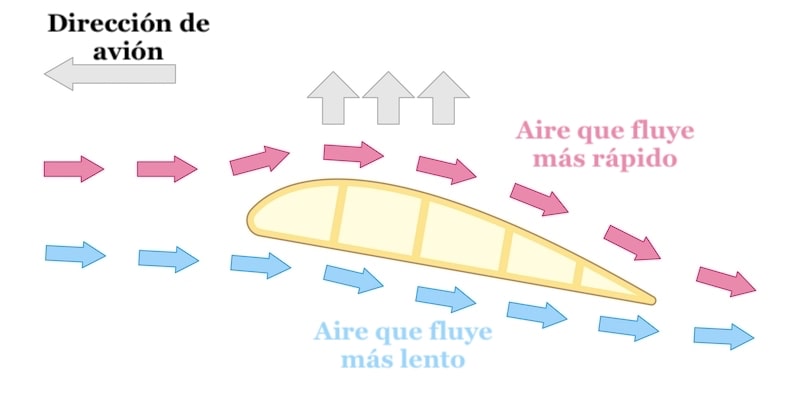
For lift to overcome gravity, an aerodynamic design of the airplane wings is required , which make the air flow faster in the upper curved portion than in the lower straight portion which generates a suction effect that prevents the plane from falling to the ground.
Thus, the faster the plane goes, that is, the more thrust produced in the turbines acts on it, the more air flows and the greater the suction, that is, the lift. This principle is known in the world of physics as Bernoulli's law, in honor of the person who formulated it in the 18th century, the Swiss physicist Daniel Bernoulli (1700-1782).
In this way, for the flight to occur it is necessary to calculate the amount of fuel that will need to be burned to achieve the necessary thrust, taking into account the design of the plane, which facilitates lift and overcomes resistance. The flight of airplanes constitutes an important triumph of engineering and design in human history.
Why can't you feel the speed in an airplane?
The reason it is possible to travel hundreds of kilometers per hour on an airplane and not feel the resistance of the wind is because Since passengers are inside a pressurized cabin, they are isolated from the air that flows at high speed on the outside . If an airplane window could be opened, the force of resistance exerted by the air could be felt, which at such heights and speeds would be dangerous for passengers.
On the other hand, once the plane has acquired its average speed, the acceleration is no longer felt (as it is felt at takeoff) because the passengers share the speed of the vehicle, that is, they move together with it, in the same way that it is not felt on a train or a bus, except when the speed varies.
Turbulence, on the other hand, which can be felt during the trip, is small imbalances in the flow of air through the wings of the plane, which are corrected immediately but have a perceptible effect on passengers.
References
- “Airplane” at https://es.wikipedia.org/
- “History of aviation” at https://es.wikipedia.org/
- “Etymology of Airplane” in the Online Spanish Etymological Dictionary. http://etimologias.dechile.net/
- “Airplane (aircraft)” at https://www.britannica.com/
- “History of flight (aviation)” at https://www.britannica.com/