
We explain everything about Uruguay and its physical and cultural characteristics. In addition, how is its economy, religion and the history of this country.
Uruguay
Uruguay is a national state whose official name is the Oriental Republic of Uruguay . It is located in South America and limits to the North with Brazil and west with Argentina. Its capital is the city of Montevideo . It is the second smallest country in South America and also one of the least populated.
Uruguay is divided into 19 states called “departments” . The most populated is the Montevideo department, where its capital is located, of the same name. The most extensive department is Tacuarembó, in the country’s center-northern, with 15,000 square kilometers.
Uruguay currently has a democratic, republican and presidential political system and is one of the founding countries of international institutions such as the UN, Mercosur, OAS and Unasur.
Why is it called “Uruguay”? During the colonial era this territory was known as the Eastern Band, then as Eastern Province, Cisplatin Province during the Portuguese-Brazilian invasion (1816-1828) and, finally, by declaring itself as an independent territory, as the Eastern Republic of Uruguay, a word of Guaraní origin. Some interpretations translate it as “Río de Urú”, “Río de los Caracoles” or “Rio de los Pájaros”, but there is no consensus about it.
Characteristics of Uruguay
Some characteristics of this country are:
- Its population is 3,485,000 inhabitants.
- It has an area of 176,215 square kilometers.
- Its capital is the city of Montevideo, which has 1,300,000 inhabitants.
- Its official language is Spanish and the most professed religion is Catholic.
- The predominant climate is the temperate warm subtropical.
- The most widespread relief is the plain.
- The candombe, tango and murga are some of the artistic expressions characteristic of the place.
- The beaches and carnival are the most important tourist attractions.
- Its main exports are related to livestock and industrial activity.
Extension, population and capital of Uruguay
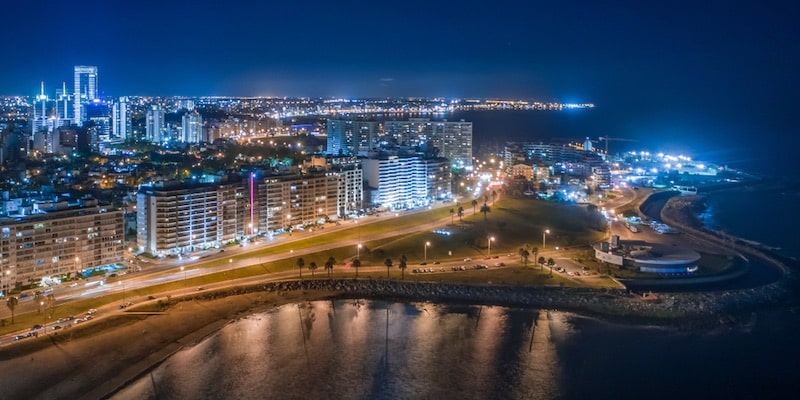
Uruguay has an extension of 176,215 square kilometers so it is the second smallest country in South America after Surinam. It has a population of 3,485,000 inhabitants and a population density of 19.7 inhabitants per square kilometer .
Uruguay is divided into 19 provincial states called “departments” . The most populated departments, in addition to Montevideo, are Canelones, Maldonado and Salto. 88 % of its population is of Spanish descent and more than a quarter of Italian ancestry. The mestizo population is just 8 % and the descendant of Africans just e. 4%. The indigenous population is almost non -existent.
The capital of Uruguay is the city of Montevideo . It has a population of 1,300,000 inhabitants, which represents 37.3 % of the country’s total. It is the administrative headquarters of Mercosur and the Latin American Integration Association (ALADI).
Climate, relief and hydrography of Uruguay
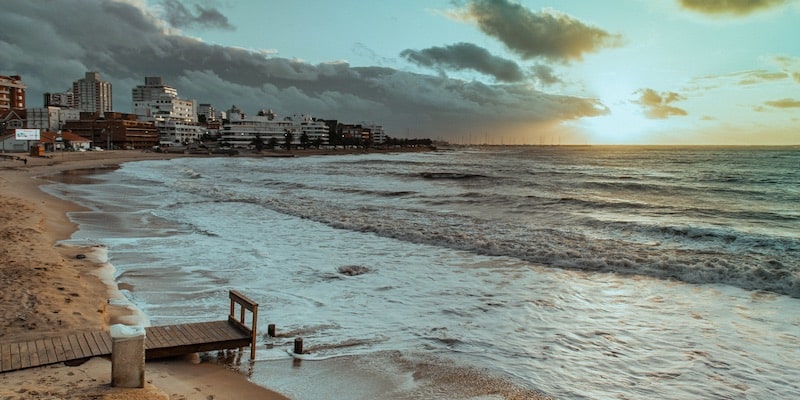
Uruguay’s climate is the temperate warpic temperate according to Köppen’s climatic classification. It has warm summers and fresh winters. Precipitation are abundant and happen at all stations of the year.
The majority of the territory is a vast wavy plain, furrowed by small hills called blades and the valleys formed by the rivers. Its highest point is the Cathedral hill with 514 meters high.
The Uruguay River is the most important of the country’s hydrography . The western limit with Argentina, and with an approximate length of 1600 kilometers is one of the most important rivers in South America.
Other important rivers of the country are the Black River, with 750 kilometers of extension and the Cuareim River with 351. In addition, A part of the Uruguayan coast is located on the Río de la Plata a wide estuary that shares with Argentina, formed by the confluence of the Uruguay and Paraná rivers
Uruguay culture
As in all American countries that were Spanish colony, the Official Language and more spoken of Uruguay is Spanish . The Spanish colonial inheritance also has influence on religion, since Most of the Uruguayan population is Catholic . African cultural contributions arrived in the continent are also important as part of the slave traffic transatlantic system during the Spanish conquest
Because the indigenous population of Uruguay is very small, very few people speak native languages of America. Only a small percentage of Uruguayans speaks Mapuche or Aymara languages linked to the original peoples that inhabited these lands before the conquest.
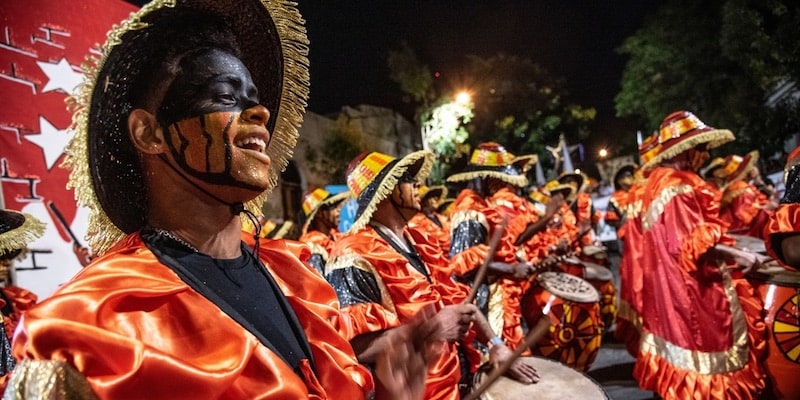
Uruguayan popular music is an integral part of the country’s cultural identity. Candombe is one of the most representative genres originated in the Afro -descendant community. Another prominent genre is tango, which has influenced Uruguayan music and has given rise to renowned interpreters and composers. The Uruguayan murga and the carnival are also part of the popular music and the culture of the country.
In the literary field, Uruguay has resulted in renowned writers as Idea Vilariño, Juan Carlos Onetti, Eduardo Galeano and Mario Benedetti considered part of the greatest exponents of Latin American literature.
The roast and the chivito They are the central elements of gastronomic culture of the country. In addition, the mate is the characteristic drink of the country and a fundamental part of the culture of the Uruguayan people.
The murga is one of the cultural manifestations for which Uruguay is recognized throughout the world. It is a musical and theatrical style, and at the same time it is how the sets that practice it are named. The murgas are usually composed of several singers who make up a choir, and percussionists of hype, dishes and redoubles. Some of the most important Uruguayan murgas in history are fungal tanners, the assailants with patent, the green devils and grab Catalina.
Uruguay national symbols
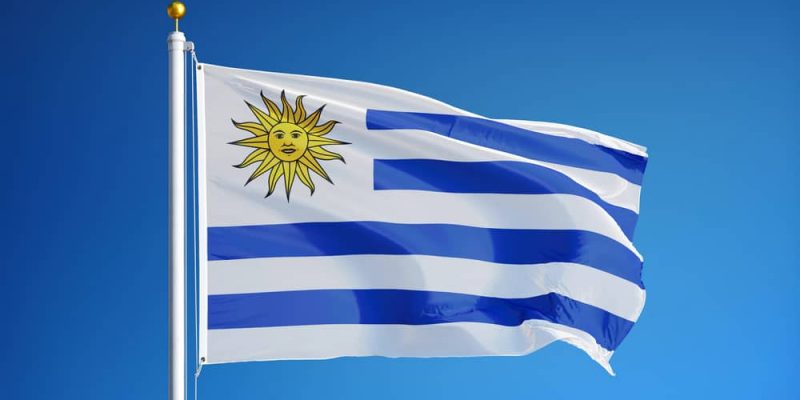
The national symbols of Uruguay are:
- The national flag . It shows the white and blue colors in horizontal stripes, next to a golden sun with a face in a upper painting next to the toast.
- The national anthem . It was written by Francisco Acuña de Figueroa and music was composed of Francisco José Debali. He was adopted as a national anthem in 1848.
- The national shield . It was created in 1908. It consists of an oval crowned by a sun divided into four quadrants. Up to the left appears a yellow balance on blue background, up to the right the hill of Montevideo, down to the left a black horse on a white background and a yellow ox on the right on a blue background. The oval is surrounded by olive and laurel branches joined by a celestial bond.
Economic Activities of Uruguay
The official currency of Uruguay is the Uruguayan weight and its main commercial partners are China, Brazil, the United States and Argentina The most important economic activities of Uruguay are:
- Livestock Vaccine livestock production represents one of the main income of the Uruguayan economy. Meat is the country’s first export product and is sold mainly to China, Brazil and the United States.
- The industry . The timber industry is one of the most important in the country and constitutes one of the most important export products. Agroindustrial products and the food and beverage industry are also important.
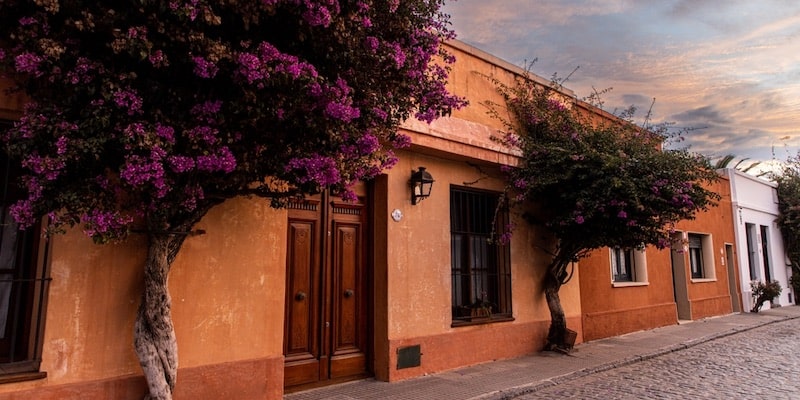
- Tourism. The cities of Montevideo, Colonia del Sacramento and Punta del Este are the main tourist destinations of the country, which attract both internal and abroad tourism. The summer and carnival months are the moments in which the country receives the largest number of foreign tourists.
History of Uruguay
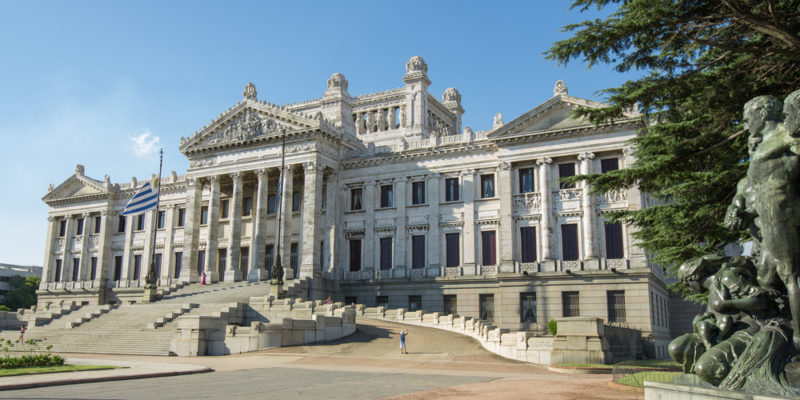
Before the arrival of Europeans, The territory of the current Uruguay was mainly inhabited by Charrúas and Guarani populations . The Spaniards arrived in 1516 and soon began the colonial era, characterized by the territorial dispute between Spain and Portugal.
The eastern band was part of the Viceroyalty of the Río de la Plata, whose capital was Buenos Aires. When the 1810 revolutionary process began, Montevideo remained faithful to the Spaniards but in the interior the revolutionary José Gervasio Artigas stood out. In 1820 the Eastern Band was annexed to the United Kingdom of Portugal, Brazil and Algarve with the name of the Cispatina Province.
In 1825 there was the insurrection of the “thirty -three oriental”, which was followed by the Brazilian war between the United Provinces of the Río de la Plata and the Empire of Brazil. His conclusion in 1828 was the recognition of Uruguay as an independent entity and the foundation of the Eastern State of Uruguay in 1830.
From then on, the Charrúas who remained in the region was persecuted and a period of political instability characterized by the struggle of factions and the involvement of neighboring countries began. This led to the Triple Alliance War against Paraguay (1864-1870).
The civil wars continued until the beginning of the 20th century, when agricultural export led to economic stability. In 1919 the name of the Oriental Republic of Uruguay was adopted. During the great depression, a coup d’etat inaugurated a dictatorship that ended in 1938.
The economic stability period was an end around the 1950s and 1960s, when the economic crisis led to the agitation of the left -wing trade sectors and at the beginning of the urban guerrillas known as “Tupamaros”. In 1973 a coup d’etat established a civic-military dictatorship characterized by the systematic violation of human rights.
Uruguay restored democracy in 1985. After an economic, political and social crisis in 2002, they occupied the Presidency Tabaré Vásquez (2005-2010 and 2015-2020) and José Mujica (2010-2015) of the Broad Front (democratic left). In 2020, Luis Lacalle Pou of the National Party (center -right) assumed.
Keep with :
References
- Ministry of Foreign Affairs (2023) Uruguay. Country record. Diplomatic Information Office of Spain. https://www.exteriors.gob.es/
- Ministry of Economy and Finance of Uruguay (2019) Regions. https://www.gub.uy/
- Official Site of Aladi. https://www.aladi.org/
- Uruguay XXI (2021) Annual Foreign Trade Report of Uruguay – 2021. https://www.uruguayxxi.gub.uy/


