
We explain what the Peace Treaties of the First World War were. In addition, its context and consequences.
What were the peace treaties of the First World War?
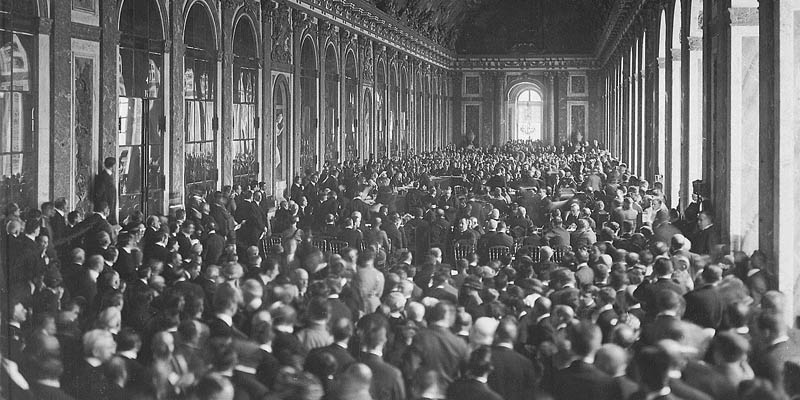
After the end of World War I that confronted the allies (the entente) with the central empires, The victors (The allies, mainly represented by the United Kingdom, France and the United States) They gathered in Paris and began to elaborate peace treaties to sign the expired nations (such as Germany, Austria, Hungary and Türkiye).
The most Important was the treaty of Versailles (1919), with which Germany was responsible for the war and on the onerous repairs were imposed. Through this treaty too The Nations Society was created an organism that had the function of avoiding new military conflicts but, in practice, had little effectiveness.

- See also: Chronology of the interwar period
The Paris Conference (1919)

On January 18, 1919, The representatives of the winning countries of the First World War met at the Paris Conference under the direction of the so -called Committee of the Four:
- Woodrow Wilson (US President)
- David Lloyd George (British Prime Minister)
- Georges Clemenceau (French Prime Minister)
- Vittorio Emanuele Orlando (Italian Prime Minister)
Who really directed the negotiations were the first three, and The defeated countries were forbidden to attend .
On October 4, 1918, the Germans had requested an armistice based on the proposals collected in the “fourteen points” of Wilson. However, the reality was much harder. The winning countries arrived in Paris with different ideas to those of the fourteen points and with commitments (sometimes secret) acquired during the war.
Some pacts signed by the entente powers during the war were:
- London Secret Treaty (1915). Italy joined the conflict together with the entente after France and the United Kingdom promised him the annexation of various regions: Trentino, Alto Adigio, Istria, most of Dalmia, Libya, Eritrea, Somalia and concessions in Asia Minor (Turkish Anatolia).
- Sykes-Picot agreement (1916). France and the United Kingdom agreed to distribute the possessions of the Ottoman Empire. Italy received vague promises about Anatolia.
- Balfour statement (1917). The United Kingdom promised the Zionist organizations that aspired to the formation of a Jewish state, the assignment of Palestine. This promise laid the basis of the future Arab-Israeli conflict.
The divergent postures of the victors at the Paris Conference
United Kingdom – David Lloyd George
- He had no territorial claims in Europe. He aspired to obtain colonial profits in Africa and Asia at the expense of the German and Ottoman empires.
- He intended the destruction of German naval power.
- In line with its traditional European equilibrium policy, I did not want to sink Germany so as not to strengthen the position of France in the continent.
- One of his key concerns was to prevent the extension of Bolshevik revolutionary agitation to central Europe and, especially, to Germany.
- He demanded war compensation.
United States – Woodrow Wilson
- Proposed the creation of the Nations Society to guarantee peace in the future.
- It sought the application of the principle of nationalities in the design of the new European borders, that is, that each national or ethnic community had its own state.
- He claimed war compensation.
France – Georges Clemenceau
- Demanded the recovery of Alsace-Lorena.
- He intended the military occupation of the western area of the RIN and the possible creation in Rhine of an independent state. This last aspiration found the opposition of the United Kingdom and the United States. In the first case, because it altered the European balance, and in the second, because it went against the principle of nationalities.
- It ambitioned the economic exploitation of the Sarre region.
- He wanted to weaken militarily to Germany.
- He opposed Anschluss (union of Germany and Austria).
- He was looking for territorial profits at the expense of the Ottoman and German empires.
- He claimed war compensation.
Italy – Vittorio Emanuele Orlando
- He claimed the application of the London Treaty: Annexation of the Trentino, the Alto Adigio, Trieste and important parts of Istria and Dalmatia. This Italian aspiration found the opposition of the United States, since the annexation of territories populated by Eslavos (Dalmatia) was against the principle of nationalities. Wilson defended the newly created Yugoslavia against Italian expansionism in the Adriatic.
- He was looking for colonial profits in the Middle East and Africa.
- He claimed war compensation.
In short, Clemenceau He personified the highest hardness position with Germany (“Germany will pay”) ; Anglo -Saxon countries, not wanting to punish Germany, opted for a more conciliatory attitude; and Italy aspired to territorial compensation that, for the most part, did not get.
The representatives of The defeated (Germany, Austria, Hungary, Bulgaria and Türkiye) were not invited to the Peace Conference . The agreements, negotiated among the victors and specified in the various peace treaties, were presented as an consummated fact that they had simply submitted.
The Germans, representatives of the newborn Republic of Weimar, signed the Treaty of Versailles on June 28, 1919 after being threatened with a total invasion of their country. In Germany there was talk of the “diktat” (the imposition) of Versailles .
Peace treaties
The Treaty of Versailles, signed with Germany (1919)
Territorial clauses
- France recovers Alsace and Lorena.
- Eupen and Malmedy go to Belgium.
- The Polish corridor (postnania and other regions) and the south of high Silesia are annexed to the newborn Poland. This means the territorial isolation of the rest of Eastern Prussia with respect to Germany.
- Danzig and Memel, Baltic German populations, are declared free cities.
- Denmark is annexed by northern Schleswig-Holstein (in the Jutland Peninsula).
- The set of territorial losses in Germany amounts to 76,000 square kilometers (13 % of its territory), where 6.5 million inhabitants lived (10 % of its population).
- The Carboniferous Basin of Sarre becomes administered by the Nations Society and economically exploited by France for 15 years.
- Germany loses all its colonies, which are distributed as mandates of the Nations Society between the British Empire and France. Belgium and Japan annexed very small territories.
Military clauses
- Drastic Limitation of the German Navy (the bulk of the Navy of War was confiscated and confined in the British base of Scapa Flow) and the German army (no more than 100,000 troops, and prohibition of tanks, planes and heavy artillery).
- Demilitarization of Rhineland (western zone and strip of 50 km east of the Rin river).
- Temporary occupation of the western shore of the Rhine. Allied troops would withdraw staggeredly in deadlines that would conclude in 1935.
War repairs
- As Germany was declared responsible for the war, it is forced to pay repairs or compensation of war to the victors.
- The Spa conference (1920) sets the percentage that each country of the total would receive: France 52 %, Great Britain 22 %, Italy 10 %, Belgium 8 %and other nations 8 %.
- At the London Conference (1921) the total amount of repairs is set: 132,000 million Marcos-Oro, an enormous sum.
Other clauses
- Germany recognizes its responsibility for war and all the damages it brought. Accept the declaration of the allies that it was the German aggression that triggered the conflict.
- Germany's entry into the newly created society of nations is prohibited.
- Anschluss (union of Germany and Austria) is prohibited.
- The pact of the Nations Society is established, as an annex to the treaty.
The Saint Germain Treaty, signed with Austria (1919)
- End of the Austrohungal Empire: Independent states such as Austria, Hungary and Czechoslovakia are born from its break. To this is added the transfer of territories to Italy and the newborns Poland and Yugoslavia.
- Austria must pay war repairs.
- Limitations are imposed on the Austrian army.
- Anschluss (the union with Germany) is prohibited.
Trianon's Treaty, signed with Hungary (1920)
- End of the Austrohungal Empire: Independent states such as Austria, Hungary and Czechoslovakia are born from its break and territories to Italy and the nascent Poland and Yugoslavia are given.
- Hungary must pay war repairs.
- Limitations to the Hungarian army are imposed.
- Important Hungarian minorities (3 million people, a third of the total population) are out of the Hungarian state, in Slovakia, Romania (Transylvania) and Yugoslavia.
The Neuilly Treaty, signed with Bulgaria (1919)
- Bulgaria suffers territorial losses for the benefit of Romania, Greece and Yugoslavia.
- You must pay war repairs.
- Limitations to the Bulgarian army are imposed.
The Treaty of Sèvres, with Türkiye (1920)
- The distribution of the possessions of the Middle East that belonged to the Ottoman Empire between France (Syria, Lebanon) and the United Kingdom (Palestine, Iraq, Transjordania) is produced in the form of mandates of the Nations Society.
- The strong territorial losses of Türkiye in Anatolia and Thracia, stipulated in Sèvres, are annulled in the Treaty of Lausana (1923) after the Turkish victory in their war against Greece (1919-1922). Türkiye is reduced to the Anatolia Peninsula in Asia and the region around Istanbul in Europe.
The Soviet problem
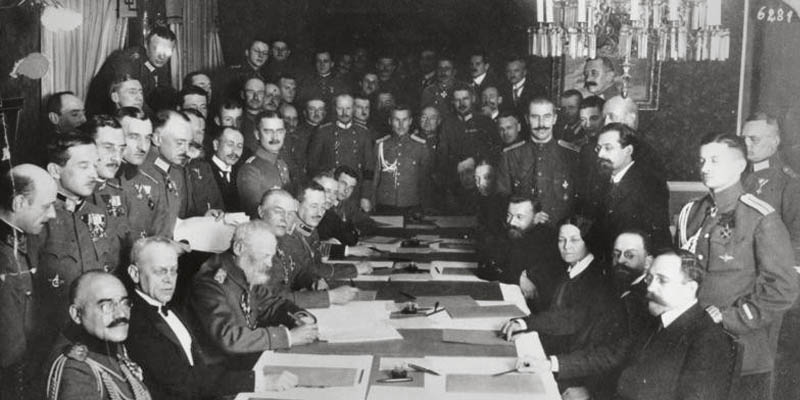
La Paz de Brest-Litovsk (March 1918) between Germany and the Bolshevik government supposed Russia's departure from war and the loss of a large number of territories for the benefit of the central empires. Lenin hastened to sign peace with the aim of focusing the efforts of the Red Army on the Civil War that had begun in Russia.
The countries of the entente supported, first with troops and then with weapons and money, to the White Army, composed of tsarists and other sectors contrary to the Bolshevik government that had been installed in Russia in November 1917.
With the situation created by the revolution, the Russian defeat against the Central empires, the Russian civil war and the subsequent victory of the entente, various territories of the former Russian Tsarist Empire reached their independence : Finland in December 1917 and the Baltic countries (Estonia, Latvia and Lithuania) throughout 1918.
Poland and the Soviet Russia faced each other in a war that concluded with the Riga Treaty (March 1921) which meant important territorial losses for Russia. Finally, Romania annexed Besarabia.
The isolation of the United States
Woodrow Wilson, president of the United States, used its influence for the constitution of the Nations Society . A key element of the new society was the principle of collective security, whereby the United States and other countries that integrated the society of nations were committed to the defense of the security of the other members .
Wilson, who was the president of the Democratic Party, had dominated by the Republican Party .
Republicans chose to introduce important amendments to the pact of the Nations Society, aimed at limiting the principle of collective security. Wilson's negative to negotiate led the problem to be solved only in the 1920 elections.
Wilson's defeat and the triumph of Republican Warren Harding caused The United States will not sign the peace treaties or the pact of the Nations Society so he was never part of this organism. However, in 1921, he signed treaties separately with Germany, Austria and Hungary.
Consequences of peace treaties
The treaties signed after the Paris Conference did not contribute to stabilize the European and world situation . The mistakes made in the elaboration of the treaties had an important role in the outbreak of World War II, just twenty years after the conclusion of the “war that would end all wars” (as it was called at that time).
Germany
Germany had accepted the armistice on the basis of Wilson's “fourteen points”. However, he was not allowed to participate in the Peace Conference of Paris and It was treated hard in the Treaty of Versailles . Clemenceau's “hard” position had been imposed.
Germany, declared responsible for the conflict, suffered territorial losses in the east and Huge war repairs were imposed, which was unacceptable for many Germans .
Revanchista positions against Versailles Treaty soon extended in Germany . The idea that the war had not been lost in the Battle Front but for “the stab in the back” of the Democrats and Socialists who constituted the Weimar Republic was spread among the German right.
Despite the economic difficulties of the early post -war years and the severity of treaties, Germany was not militarily occupied, temporarily except some areas from Rhineland and the Sarre basin, so its economic power did not suffer a substantial decrease. Finally, After overcoming hyperinflation crises, it remained a powerful state .
Italy
After signing the peace treaties, in Italy The phrase “We have won the war was repeated, but we have lost peace.” This summarized the generalized feeling of having been belittled in Paris and having achieved few benefits after having lost more than half a million human lives during the conflict.
The Italian non-annexation of territories in Dalmia (due to the application of the principle of nationalities in New Yugoslavia) and the insignificant colonial conquests caused by Franco-British pressure made the annexations of the Trentino-High Adigion and the Istria peninsula (9000 square kilometers) seem very little territorial gain against the sacrifice made during the war. This led to The idea of a “mutilated victory”, which favored the growth of Italian fascism .
Central and Eastern Europe
The application of the principle of nationalities to such a complex reality (from ethnic and linguistic) such as central and eastern Europe caused a complicated border design work that tried to separate what was often inseparable.
The presence of national minorities in the new states arising in the region was frequent. The area was full of conflict spotlights .
France
Despite imposing hard conditions on Germany, France did not get that the Anglo -Saxon countries promised to sign a pact that guaranteed their support before an eventual German attack . The American refusal to sign the peace treaties prevented this French aspiration.
The fragility of the French position was clear as Adolf Hitler began the German rearmament in the thirties. Clemenceau had made Versailles treaty very hard with Germany, but had not achieved a situation of strength that allowed its application.
USA
The hegemony of Republicans during the twenties in the United States marked a clear isolationist tendency. The refusal to enter the Nations Society led to An unevenness of European political affairs which was harmful to world stability, because the United States was already the first world power.
However, in the economic field Americans did not opt for isolationism . This was seen in his refusal to forgive the debts of the allies of the entente or in his speech to solve the problem of German war compensation through the 1924 Dawes Plan.
Russia
The allied powers intervened in favor of the White Army during the Russian Civil War. After beating the First World War, they chose to establish what was called “Sanitary Cord” around the territory controlled by the Bolsheviks (which was then established as the Soviet Union).
It was about establishing antisovieths that fence the new Bolshevik regime, weakened the Soviet Union and prevent the expansion of communism to the west. The Bolshevik Russia (and then the Soviet Union ) It was isolated and was not allowed to enter the Nations Society
The Nations Society
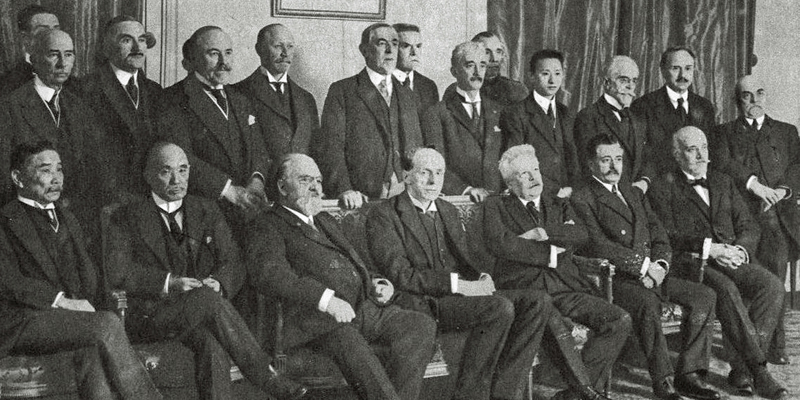
The president of the United States, Woodrow Wilson, made the Paris Conference, which had initiated its sessions on January 18, 1919, approved a resolution on the creation of a company of nations on the 25th.
In April, the conference approved the Pact of the Nations Society, which was attached to the various peace treaties. He entered into force in June 1919, when the Treaty of Versailles was signed . The Society of Nations set its headquarters in Geneva (Switzerland).
Its main objective was the maintenance of peace so it sought to guarantee the protection of small countries to the great powers. It was about creating a new international order based on the principle of collective security .
The society of nations achieved some successes: helped peacefully resolve some conflicts in the immediate period of the postwar period and had its peak in the period 1924-1929 (with the Treaty of Locarno of 1925, the entry of Germany into society in 1926, or the Briand-Kellogg pact in 1928).
However, when the international situation was convulsed After the depression of 1929, the Nations Society He was totally unable to keep the peace .
Among the proposed reasons for the failure of the Nations Society historians usually coincide in two. The first is The absence of some important powers In the organism:
- The United States refused to enter 1920 and never participated.
- Germany was denied at the beginning the income; He adhered in 1926, but retired after Hitler's rise in 1933.
- The Soviet Union was also denied admission, agreed in 1934 and was expelled in 1939.
- Japan left in 1933 and Italy in 1937.
The second reason for the failure of the Nations Society was The lack of economic or military means to impose your resolutions.
Continue with:
- PERIOD OF DELIVERY (1919-1924)
- Chronology of the interwar period
- Decolonization in the twentieth century
- Imperialism
References
- Britannica, Encyclopaedia (2022). League of Nations. Britannica Encyclopedia. https://www.britannica.com/
- Britannica, Encyclopaedia (2022). Treaty of Versailles. Britannica Encyclopedia. https://www.britannica.com/
- Sevillano Calero, F. (2020). The Europe of award. The disrupted order. Synthesis.
- Stone, N. (2013). Brief History of World War I. Ariel.


