
We explain everything about Chile and its physical and cultural characteristics. In addition, how is its economy, religion and the history of this country.
Chili
Chile is a national state whose official name is the Republic of Chile. It is located in South America and limits east with Argentina, to the north with Peru and the Northwest with Bolivia. To its west is the Pacific Ocean. Its capital is the city of Santiago de Chile .
Chile is a narrow but very extensive country in length : It has an average width of 180 kilometers and its longitudinal extension is 4270 km.
It is administratively divided into 16 regions . The most extensive is the Magallanes region in the south of the country, with 132,000 km2. The most populous is the Santiago Metropolitan Region, where its capital is located, with more than 8 million inhabitants.
Chile currently has a democratic, republican and presidential political system. It is part of the Community of Latin American and Caribbean States (CELAC), of the Pacific Alliance, the Organization of American States (OAS) and the United Nations Organization (UN).
Why is it called “Chile”? The origin of his name comes from a term that was used before the conquest. At that time, the areas located particularly in the Atacama desert were called “Chili”. Once the Spaniards conquered the Chilean lands, they continued to use this name that was often named as “Chile Valley”
Chile’s characteristics
Some characteristics of this country are:
- Its population is 19,500,000 inhabitants.
- It has an area of 756,945 km2which represents a population density of 25.7 inhabitants per square kilometer.
- Its capital is the city of Santiago de Chile.
- The official language is Spanish and the predominant religion is the Catholic.
- Its predominant relief is the mountainous.
- Being in an area of tectonic plates edges, volcanic eruptions and earthquakes are frequent.
- Its predominant climate is the cold arid in the north and the temperate oceanic in the south.
- In its territory is the Atacama desert, the most arid in the world.
Extension, population and capital of Chile
Chile has an extension of 756,945 square kilometers so it is the most extensive seventh in South America. It has a population of 19,500,000 inhabitants, and a population density of 25.7 inhabitants per square kilometer.
Chile is divided into 16 administrative regions. The most populated regions are the Santiago Metropolitan Region where its capital is located, with 8,300,000 inhabitants, Valparaíso with 2,000,000 and biobío with 1,600,000.
Most of its population is Spanish descent Like all South American countries that were colony in Spain. In addition, approximately 13 % of the population is considered a descendant of native peoples of the region.
The capital of Chile is the city of Santiago . It has a population of 5,300,000 inhabitants and its metropolitan area exceeds 7,100,000, which represents 36.4 % of the country’s total.
Easter Island
The Easter Island, also known as Rapa Nui in the native language of its inhabitants, is a territory belonging to Chile located in the Pacific Ocean, at approximately 3,700 kilometers west of the Chilean coast. The island has an extension of approximately 163 km2 and a population of almost 8000 inhabitants. Politically it is part of the Valparaíso region. It is considered one of the most isolated areas inhabited by the human being in the world.
Easter Island is famous for its monumental stone statues known as Moáiswhich are considered a World Heritage by UNESCO. These stone sculptures were carved by the ancient inhabitants of the island between the 10th and 16th centuries and constitute the main tourist attraction of the island.
Climate, relief and hydrography of Chile
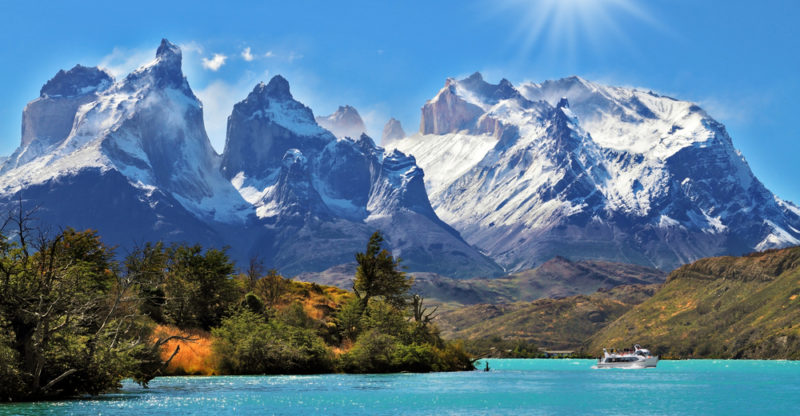
Chile’s main relief structures are:
- The Andes mountain range . It is a mountain range that crosses almost the length of the total of South America and has a great extension in the territory of Chile. It is composed of high altitude mountains and volcanoes. Its highest peak is the snowy eyes of the Salado, which with 6893 meters high is the highest volcano on the entire planet.
- Intermediate depression . It is a depression located between the Andes mountain range and the Cordillera de la Costa. This region concentrates most of the population and is where the city of Santiago is located.
- The Coast of the Coast . It is a mountain range that extends to the north of the country, specifically south of Arica. Then, in the central area it begins to decline its altitude and mixes with other rocky chains.
- The coastal plains . They are low and narrow areas that are between the Pacific Ocean and the Cordillera de la Costa.
For being in an edge area between the Nazca plate and the South American plate, Much of the territory of Chile is on a seismic and volcanically active area . The Valdivia earthquake in 1960 was one of the most magnitude of the history and eruption of the Puyehue volcano in 2012 was also very significant: its ashes extended thousands of kilometers from the volcano.
The predominant climate of Chile is the cold arid in the north and the oceanic temperate in the south . The cold aggregate is characterized by low temperatures as a result of altitude, and its few rainfall. In the north is the Atacama desert, the most arid in the world.
In the south, oceanic temperate climate and one of its variants, the Mediterranean temperate predominates . In this climate the temperatures are high in summer and low in winter, and rainfall is concentrated in the winter months, while summer is usually less cold and dry.
Chile’s hydrography is characterized by having short and temporary streams in the north, conditioned by the aridity of the climate. In the center and south there are more extensive and caudalous rivers like Loa and Biobío. The Loa River, with 440 kilometers of extension, is the longest in the country.
As for the flora, To the north the desert climate generates scarce vegetation adapted to the lack of rain such as cactus. Towards the center of the country, vegetation increases because they also increase moisture and rainfall, and plants such as magnolias, diversity of conifers and laurel can be found. Towards the southern part of the country, thanks to the cold climate, there are more middle and high trees but little vegetation in the mountainous areas.
Fauna is also very varied: north of the country You can see flames, vicuñas and guanacos, animals adapted to the extreme aridity ; To the south you can find pumas, Andean wolves, chinchillas and pudúes.
The Atacama Desert
The Atacama desert is in northern Chile. It has an approximate extension of 105,000 square kilometers. It is considered the most arid desert in the world. Its average rainfall barely reaches 50 millimeters per year, but throughout its history periods of more than 400 years without rains have been recorded. Because of its geological and climatic characteristics similar to those of Mars, NASA scientists use it to perform space tests.
Chile’s culture
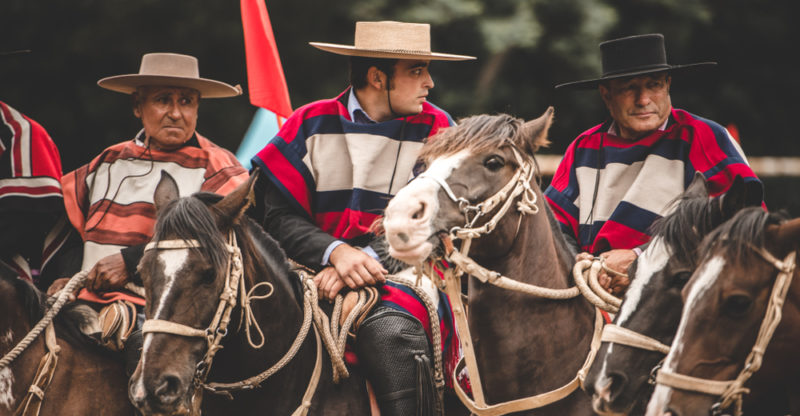
As in all American countries that were Spanish colony, the Official and more spoken language in Chile is Spanish . The Spanish colonial heritage also has influence on religion, since most of the Chilean population is Catholic.
Because the indigenous population of Chile is reduced, very few people speak native languages of America. Only a small percentage of Chileans speaks charrúa or Guaraní languages linked to the original peoples that inhabited these lands before the conquest.
In the field of music, the greatest referents of Chilean popular music are Violeta Parra and Victor Jara and musical ensembles such as Inti Illimani, Quilapayún and Los Jaivas.
Pablo Neruda and Gabriela Mistral both winners of the Nobel Prize in Literature. Roberto Matta, Claudio Bravo, Judith Alpi and Tatiana Álamos stand out in the field of plastic arts.
Some typical dishes of Chilean cuisine are the roast of Lamb and the Charquicán, which is prepared with Charqui and Rice. Your typical drink is the pisco made with grape brandy.
Home symbols of Chile
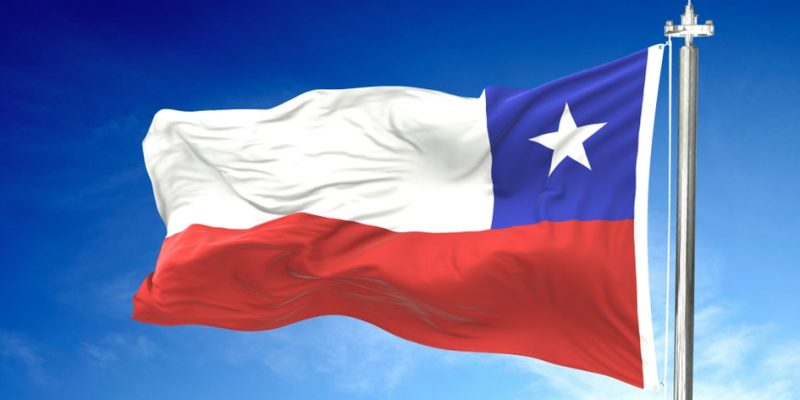
The national symbols of Chile are:
- The flag of Chile. It is divided into two horizontal stripes. The upper one is a blue third with a five -pointed white star and two thirds white. The lower one is red. It was adopted as a national flag in 1817.
- The National Anthem of Chile. The lyrics were composed of Eusebio Lillo and the music by the Spanish Ramón Carnicer. He was adopted as a national anthem in 1847.
- The coat of arms of Chile. It consists of a five -pointed golden star on a blue and red bottom. In the upper part appears a white, red and blue tricolor plumage. On the sides appears a huemul and a condor. At the bottom the shield is supported on a golden crown crossed by a white ribbon with the motto “For reason or strength.” It was adopted in 1834 and modified to acquire its current final design in 1967
Chile’s economic activities
The most important economic activities of Chile are:
- Agriculture It is practiced mainly in the regions of the center and south of the country, where rainfall is more abundant. Products such as corn, wheat and fruits such as pears, grapes, peaches and apples stand out.
- Mining It is the main economic activity of the country. Its exports represent 55 % of the country’s total. Products such as copper, lithium, iron, silver and gold stand out.
- Tourism. The most visited tourist sites in Chile are its capital Santiago, the cities of Valparaíso and Viña del Mar, and Easter Island.
Its official currency is the Chilean weight, and its main commercial partners are China, the United States, Japan, Brazil and Argentina.
History of Chile
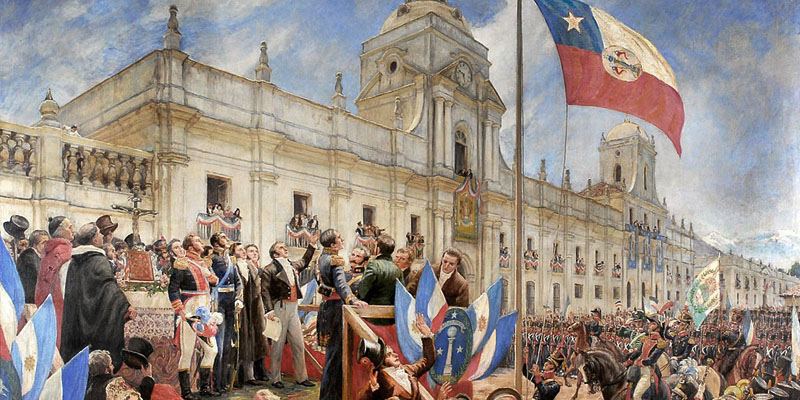
At the end of the 15th century, the north of the current territory of Chile was conquered by the Inca Empire. The Inca expansion stopped around the Maule River due to the resistance of the Mapuche or Araucanian populations that inhabited the central and southern Chile.
After the fall of the Inca Empire against the Spaniards in the 16th century, the Spanish conquest of the Chilean territory began. In 1541, the conqueror Pedro de Valdivia founded Santiago and settled together with a group of settlers who distributed the lands in the form of estates.
In 1550, Valdivia founded Concepción and began the expansion to the south. Mapuche Lautaro military leader headed a revolt that led to the capture and murder of Valdivia in 1553. This fact began a long war between Mapuches and Spaniards or Creoles that continued intermittently until the end of the nineteenth century.
The General Captaincy of Chile was part of the Viceroyalty of Peru until 1798, when it was separated by order of the Spanish king. In 1810, given the power vacuum caused by the Napoleonic invasion of Spain, a Government Board was formed in Santiago. After a brief period of restoration of Spanish power, The patriots troops commanded by José de San Martín defeated the realists and in 1818 the independence was declared.
Bernardo O’Higgins was elected Supreme Director and during his government tried to remove some privileges from the landowner oligarchy, so he had to exile in 1823. After a few years of political instability, a stage of hegemony of the conservative oligarchy (1830-1861) and liberal governments (1861-1891) began. Between 1879 and 1883 territory was won to Peru and Bolivia after the victory in the Pacific War.
In 1891 Chile became a parliamentary republic and In 1925 a presidential republic was established. During the dictatorship of Carlos Ibáñez del Campo (1927-1931) there were nationalizations and other economic reforms. Since then, liberal and radical governments alternated until the presidency of Christian democracy in 1964.
In 1970, the socialist Salvador Allende was elected, who promoted an agrarian reform and was overthrown by a coup in 1973. General Augusto Pinochet headed a dictatorship until 1990, when democracy was restored . Since then, the Chilean government is characterized by political alternation.
Continue with:
References
- Economic Activities (2023) Economic activities of Chile. https://activitieseconomicas.org/
- Aquae Foundation (SF) The Atacama desert, the most arid in the world. https://www.fundacionaquae.org/
- Ministry of Foreign Affairs (2023) Chili. Country record. Diplomatic Information Office of Spain. https://www.exteriors.gob.es/
- National Geographic (SF) Easter Island, The Pacific Treasury. https://viajes.nationalgeographic.com.es/
- 20 minutes portal (2018) The rain reaches the Atacama desert for the first time in 500 years and causes a massive extinction of its microbial life. https://www.20minutos.es/


