We explain how the colonial era in Mexico was. In addition, the most important events and their political, social, economic and cultural characteristics.
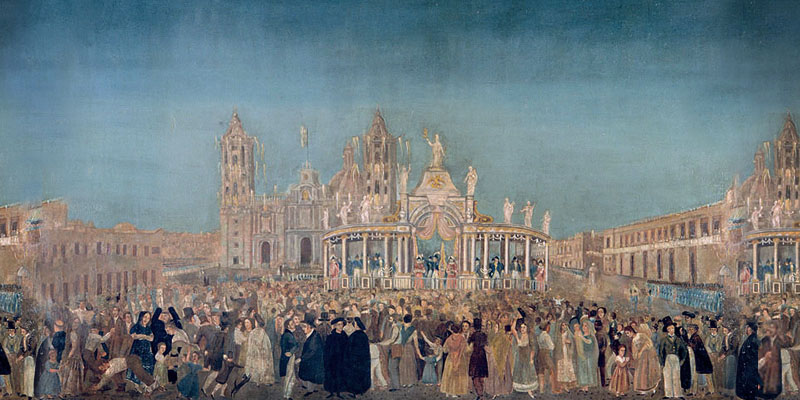
How was the colonial era of Mexico?
The colonial era of Mexico It was the historical period that began in the 16th century, with the Spanish conquest of the Aztec Empire (or Mexica) headed by Hernán Cortés, And he ended with the war of independence between 1810 and 1821, which led to the formation of an independent Mexican State.
During the colonial period, Mexico was part of the New Spain Viceroyalty, founded in 1535 and governed by a viceroy who was appointed by the King of Spain. Together with the Viceroyalty of Peru and the Viceroys of New Granada and the Río de la Plata formed the territorial and political regime of America colonized by the Spanish monarchy.
Like all the territories of America colonized by Spain, Mexico was political, religious, culturally and socially remodeled according to the values and interests of the Spaniards . This generated that many traditions and institutions of indigenous populations that survived the conquest were prohibited or marginalized.
The colonial era of Mexico was characterized by a social division based on estates in which the “whites” (peninsular Spanish and Creoles) had a privileged position in front of the “Indians” (indigenous populations), “blacks” (Africans or descendants of Africans) and the different categories of mestizos. However, cultural exchange generated original forms of religious syncretism, as well as specifically colonial artistic styles.
Frequent questions
When did the colonial era in Mexico begin?
The colonial era in Mexico began in 1521, after the defeat of the Aztec (or Mexica) Empire in front of the Spanish conquerors headed by Hernán Cortés.
How was the colonial era in Mexico?
During the colonial era, Mexico was the center of the Viceroyalty of New Spain. The viceroy ruled on behalf of the King of Spain and society was divided into estates based on origin. The colonial economy consisted of obtaining resources from America for shipping to Europe.
How many centuries did the colonial era in Mexico?
The colonial era in Mexico covered a period of three hundred years, between the Spanish conquest in 1521 and the declaration of independence of the Mexican State in September 1821.
How did the colonial era in Mexico end?
In Mexico there was an insurrection in 1810 that began the war of independence between insurgents and realists. The war ended in 1821 with the victory of the independence forces. On September 28, 1821, the Mexico Independence Act was signed that ended the colonial era.
History of the colonial era of Mexico
The conquest of Mexico

After the expeditions of the Christopher Columbus navigator to the coast of the Caribbean at the end of the 15th century, various Spanish explorers and military launched the conquest of territories in America in the name of the crown. One of them was Hernán Cortés, who had participated in the conquest of Cuba, and who in 1519 directed a group of men towards the territory of the current Mexico.
At that time, the region was dominated by the Aztec (or Mexican) Empire, governed by Emperor Moctezuma. Its capital was Tenochtitlán, where Mexico City is located today. Despite the Mexican resistance, The Spaniards had technological superiority (gunpowder, horses, armor) and with the tactical skills of Cortés, who established alliances with various indigenous populations that were subjected or enmity with the Aztec empire, such as the Tlaxcaltecs.
Tenochtitlán was taken by the Spanish conquerors in 1521, which ended the Aztec empire Already a war that caused huge human losses for Mexicans, later aggravated by the diseases introduced by the Spaniards (such as measles). Cortés was appointed governor of New Spain in 1522 and continued his conquest expeditions in areas that later became part of the Viceroyalty of New Spain.
The Viceroyalty Foundation of New Spain
He New Spain Viceroyalty It was founded in 1535 fourteen years after the fall of Tenochtitlán, and was built on the ruins of the Aztec civilization. He was governed throughout his history by 62 Viceroyes, who fulfilled the function of representatives of the King of Spain.
The first Viceroy of New Spain was Antonio de Mendoza and Pacheco, who assumed the position in 1535. The expansion of the viceroyalty continued for many years, since the Spaniards continued to fight the northern peoples and their former allies. As a result of these actions, Many conquerors received “parcels”, groups of indigenous people forced to work for the encomendero in exchange for this to meet their basic needs and instill in them the Catholic faith.
New Spain’s viceroyalty territory was very extensive . He came to cover what Mexico is currently, along with the current US states of California, Nevada, Colorado, Utah, New Mexico, Arizona, Texas, Oregon, Washington, Florida, Louisiana, Wyoming, Kansas, Oklahoma, Montana and Idaho parts. It also included the southwest of the British Columbia in the current Canada, all of Central America, the current Cuba, Dominican Republic, Puerto Rico, Trinidad and Tobago and Guadalupe and, in Asia and Oceania, the Philippines and the Caroline and Marian Islands. He was the largest and main Spanish colonial settlement of the time.
The end of the colonial era
With the arrival of the Bourbons to the throne of Spain in the 18th century, the administration of the colonies in America experienced some changes. Bourbon reforms promoted more direct control of the crown on the government and finance of the viceroyalty which included the creation of the intendancies regime and the expulsion and seizure of the properties of the Jesuits that were in the region evangelizing.
The increase in taxes and the exclusion of the Creoles of administrative positions, which were left to peninsular Spaniards, encouraged the discomfort of many Creoles in these years. In 1808, the invasion of Spain by the French army of Napoleon Bonaparte and the capture of King Fernando VII replaced on the throne by Napoleon’s brother, produced a power vacuum that was conducive to military uprising in the colonies, especially encouraged by the Creoles.
In the Viceroyal of New Spain, the insurrection began in 1810 with the shout of Dolores . This led to a long war of independence that culminated in 1821 with the triumph of the independence forces and the signing of the Mexican Independence Act. From that moment, the colonial era in Mexico ended. However, Spain recognized the independence of Mexico only in 1836.
Characteristics of the colonial era in Mexico
The political and territorial organization
The New Spain Viceroyalty was so extensive that it required a political division in general kingdoms and captains:
- Kingdoms: Kingdom of New Spain or Mexico (included the central nucleus of the viceroyalty), kingdom of Nueva Galicia, kingdom of Nueva Vizcaya, New Kingdom of León, kingdom of New Extremadura, among others.
- General Captainies: Philippines, Cuba, Puerto Rico, Santo Domingo, Yucatán and Guatemala (also considered a kingdom).
These territorial and administrative divisions were governed by a governor or a captain general who responded directly to the author’s authority. In turn, The viceroy was the personal representative of the King of Spain in the viceroyalty .
Anyway, In the areas farthest from the center of the viceroyalty, governors and audiences (institutions in charge of the administration of justice) They had more authority than the viceroy, like the corregidores and major mayors in the corregimientos or manors.
The intendance regime established by the Bourbons in the 18th century implied greater control of the Spanish monarch on the Viceroyalty finances, which were in charge of a Treasury Superintendent. Besides, The kingdoms were largely replaced by twelve intentions in charge of officials appointed directly by the king.
After the Napoleonic invasion of Spain at the beginning of the 19th century, the Cortes of Cádiz, who did not know the authority of the King imposed by Napoleon, promulgated the Spanish Constitution of 1812 that identified the overseas territories as “provinces” . In this decision some American deputies influenced, such as Mexican Miguel Ramos Arizpe and Chilean Joaquín Fernández de Leiva.
However, after the restoration of Fernando VII on the Spanish throne in 1814, the viceroyalty was restored. Its final dissolution took place when a liberal government formed in Spain in 1820, but the viceregal structure remained until the realistic army was defeated in the War of Independence in 1821.
The colonial society
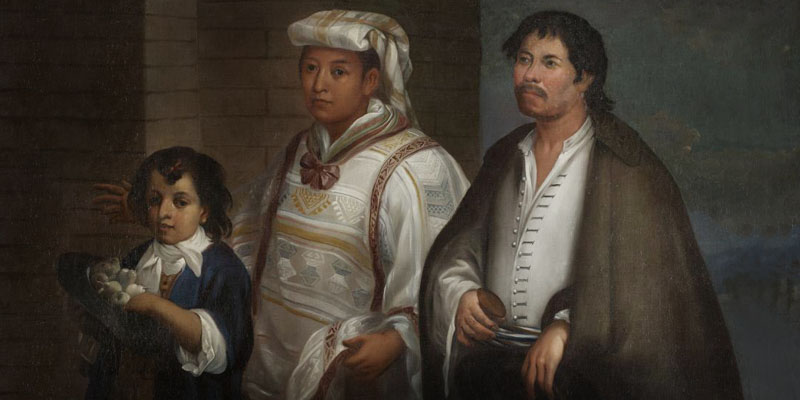
The colony society was organized in estates based on an idea of division and mixing of “races.” This means that The political, economic and social position of individuals was conditioned by their origin or belong to a certain ethnic group.
The colonial social structure of New Spain (and of Hispanic America in general) consisted of the following groups or estates:
- “White.” Were the Spaniards, who were differentiated in two groups:
- Peninsular They were the Spaniards born in Europe, owners of the colonized lands in New Spain and belonging to the highest political and religious hierarchy.
- Creoles They were the Spaniards born in America, belonging to the privileged class but without the same benefits as the peninsular, with moderate access to political power and generally dedicated to trade, bureaucracy or clergy.
- “Indians.” They were the indigenous populations of the territories that remained under the authority of the Viceroyalty of New Spain (and other viceroyalty). They were descendants of the pre -Columbian peoples, who generally lost their lands and were subjected to the economic exploitation of the “whites” (initially through forced labor and then as wage earners), except the noble indigenous people who generally were treated in the likeness of the “whites.”
- “Black.” They were Africans and Afro -descendants who were bought and sold as slaves and employees in plantations, mines and other activities in American territories.
- “Mestizos” and other castes. They were descendants of the union of “white” with “India” (“mestizos”) or other unions between different groups that received the generic name of “castes.” Of these groups, the “mestizos” were the least harmed, because in many cases they could integrate into Hispanic society.
The colonial economy
The colonial economy in New Spain was oriented to Resource extraction, largely sent to Europe through the port of Veracruz . The port of Acapulco, on the coast of the Pacific Ocean, served to obtain the products from the Philippines (such as silks), which were also subsequently sent to the Peninsula.
Gold and silver mining in northern Mexico sites such as San Luis Potosí or Zacatecas, required the use of abundant labor and, in the case of La Plata, it was the main novohispana export to the Peninsula. This at the same time promoted infrastructure works and agricultural expansion in mining areas.
The other main activity was Agriculture, both for internal consumption and for export to Europe (for example, cocoa and sugar) . In general, estates or stays administered by Spaniards and dedicated to the breeding of cattle and crops such as wheat, in addition to sugar mills and textile works. Species such as corn were also produced, which were part of the diet of indigenous populations. Imports from Europe included oil, wine, fabrics and various furniture and tools.
Ultramarine trade was in the hands of Spanish merchants and was a monopoly of the crown, which promoted smuggling and piracy practices . This at the same time generated the need to apply the fleet and galleons system (the joint navigation of several merchant ships escorted by war ships). During the time of the Bourbon reforms some trade liberalization measures were implemented, but the Spanish monopoly of trade with America continued.
Evangelization and Church
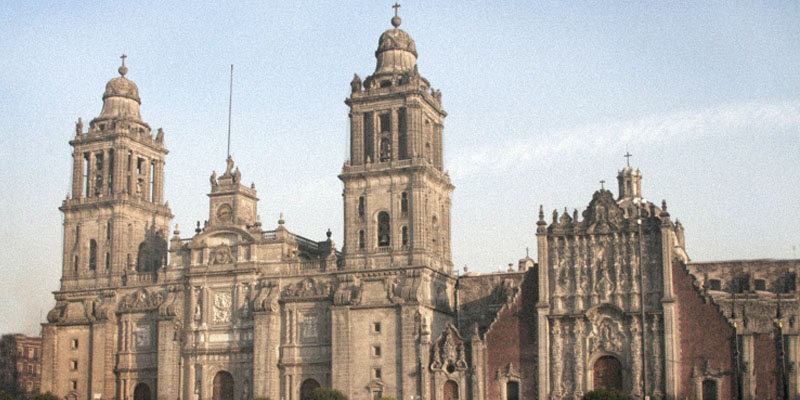
Part of the process of conquest and colonization of New Spain consisted of the evangelization of indigenous populations, whose religious traditions were considered pagan and idolaters. The task of “saving” the souls of the indigenous people, as this task was understood, was in charge of the Mendicant orders, mainly the Franciscans, Dominicans and Augustinians. The Jesuits also dedicated themselves to evangelizing although they were expelled from America in 1767.
Generally, convents were built with schools for the education of the indigenous people, while destroying pre -Hispanic temples, images and codices. At the end of the 16th century, most natives had been converted to Catholicism . In any case, at this time there was also religious syncretism, that is, the combination of Christian and indigenous symbols, and also emerged mostly Creole cults, such as the veneration of the Virgin of Guadalupe.
In the colonial era, The Novohispana Church was organized in the Archdiocese of Mexico and the Diocese of Tlaxcala, Michoacán, Antequera, Chiapas, Yucatán and Nueva Galicia, independent of the viceroy but subjected to the King of Spain and the Pope. However, indigenous parishes largely controlled by religious orders.
With the Catholic Church, The Holy Office of the Inquisition also arrived in New Spain that imposed punishments to people condemned by heresy (as considered Judaism and Lutheranism) or for minor doctrinal offenses. He also censored books. However, The natives were excluded from the Inquisition Trials .
Culture, art and urban expansion

In the Viceroyalty of New Spain, integration over three hundred years of history of Spanish culture with Mesoamerican indigenous cultures (Zapoteca, Mixteca, Maya, Nahua) resulted in a society with particular characteristics, which incorporated many words of Nahuatl origin into the Spanish language and contributed novel artistic manifestations.
Novohispana literature had outstanding figures such as Sor Juana Inés de la Cruz and Juan Ruiz de Alarcón. In the field of architecture, painting and sculpture, mannerist and baroque novohispano styles stood out.
In Mexico, the first institution of higher training in America, the College of the Santa Cruz de Tlatelolco, oriented to indigenous young people and where the Franciscan Bernardino de Sahagún was founded in the 16th century. Besides, In 1551 the Royal and Pontifical University of Mexico was created.
During the colonial era, many of the main cities of the current country in Mexico were settled and of the other regions that were part of the Viceroyalty of New Spain. This was carried out in many cases according to a criterion that planned cities from scratch. It was not the case of Mexico City, built on the old Tenochtitlán.
})
References
- Brading, Da (1991). Indian orb. From the Catholic monarchy to the Creole Republic. Economic Culture Fund.
- Britannica, Encyclopaedia (2013). Viceroyalty of New Spain. Britannica Encyclopedia. https://www.britannica.com/
- León-Portilla, M. et al. (1990). Latin America in the colonial era. 1. Spain and America from 1492 to 1808. Criticism.von Wobeser, G. (2010). History of Mexico. Economic Culture Fund.