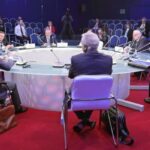
We explain what a discussion panel is, its characteristics, function and examples. Furthermore, the elements that compose it.

What is a discussion panel?
A discussion panel It is a debate format both publicly and behind closed doors, in which a group of invited specialists, called panelists, take turns presenting their opinions on a topic specific. This type of event is very common in the specialized field, especially politics and academia, and they usually address a topic of common interest, whether scientific, legal or any other nature.
Discussion panels can be organized in a very diverse way, some facing the general public and others as part of events of a technical or specialized community, such as congresses or guild meetings. Your guest panelists, likewise, may consist of specialists, voices of authority, researchers or commentators and opinion leaders.
In general, these types of debates are usually brief (two to three hours) and consist of an initial presentation by each panelist and then an exchange of arguments around the topic, allowing for replies and interruptions. They are almost always under the coordination of a moderator who ensures order and the preservation of forms.
Features of a discussion board
Broadly speaking, a discussion panel is characterized by the following:
- Has 2 or more guest panelists (usually 5 is considered a maximum limit), to generate a contrast or diversity of opinions, and a moderator or coordinator to lead the debate.
- Give each panelist an opportunity to present their ideas in a coordinated manner and without interruptions, which usually does not exceed 10 or 15 minutes. Subsequently, the debate occurs, in which the free exchange of arguments, interruptions and replies are allowed, as long as composure is preserved.
- Each panelist defends a point of view regarding the matter, expanding it when deemed necessary. If all the panelists freely debate the available points of view on the matter, and everyone has an equal opportunity to intervene, we will be more in the presence of a round table.
- The public does not usually have any margin of participation in the debate, beyond asking questions if the moderator allows it. On other occasions, questions can be reserved for the end.
- The event ends, ideally, with the formulation of joint conclusions and some type of agreement or determination.
What is a discussion panel for?
The discussion panels serve to address a specific topic in the most complete or diverse way allowing the contrast of points of view and giving room for debate and argumentation by specialists in the field.
It is a fairly flexible, organized and, if everything goes well, peaceful discussion format. Thus, it allows conclusions to be reached for an interested public, and at the same time encourage healthy debate and understanding in matters of public or general interest.
Elements of a discussion panel
The discussion panels include the following elements:
- The panelists or guests who represent in the debate the different points of view on the matter that will have to be contrasted. Each one must have an opportunity to present their ideas without interruptions, and then the opportunity to defend them argumentatively in front of the other panelists.
- The moderator or coordinator generally only one, is in charge of ensuring manners and fairness both in the presentation and in the debate, managing the time available to each person and serving as a bridge between the specialists and the public when asking questions.
- An interested public whose nature can be very diverse, but which constitutes the ultimate recipient of the ideas presented during the debate. At the end of the panel, the public will take away the conclusions obtained and the answers to the questions they have asked.
Importance of the debate
The debate It is an activity of vital importance to the health of a democracy and a peaceful society. Contrary to what one might think, civilized verbal confrontation between different points of view on a matter tend to reflect the complexity of reality and promote tolerance towards the reasons of the other, opening spaces for the healthy exercise of listening to the other, even when one thinks differently.
In a debate it is the ideas that are opposed, not the people who wield them, and even in the most fierce or exciting moments of a debate, attention must be paid to forms and norms of communication that, in some way, give everyone equal opportunities to express themselves . That is why the debate is found within the organization of public power, in the case of the Legislative Assemblies.
Discussion Board Examples
Below are some premises for organizing a discussion panel, as an example:
- Bullying or bullying . Why does it occur and what measures should be taken to stop it in time, and prevent it from becoming a more serious phenomenon? This panel could include: a school psychologist, a school director or educational coordinator, a child psychoanalyst, etc.
- The risks of social networks regarding privacy . To what extent should the exposure of the intimate be allowed? What risks are involved in Social Networks and how can we avoid them? This panel could include: a social media researcher, a computer technician, a social psychologist, a sociologist, etc.
- Latin American political integration facing the 21st century . In what way can Latin American nations cooperate for their mutual benefit in political, economic and social matters? What are the models to imitate and what are the scenarios to avoid? This panel could include: a political scientist, a career politician, a member of a Latin American NGO, etc.
- The legalization of abortion . What is the best way to approach the pros and cons of a legal abortion law? What are the limits that should be established and what are the risks and benefits? This panel could include: a gynecologist, a feminist activist, a politician, a philosopher, etc.
References
- “Discussion panel” on Wikipedia.
- “The discussion panel” in Language Blog.
- “How to organize a discussion panel” at Universia (Peru).
- “How is a panel organized and developed?” at Escuela Superior Politécnica del Litoral (Ecuador).