We offer you a complete summary of what was the second industrial revolution, its key characteristics, revolutionary inventions, and how society transformed.
What was the second industrial revolution?
The second industrial revolution was a process of technical innovations and economic transformations that It began approximately in 1870 and extended until the beginning of World War I, in 1914 . It was a time of important economic and social changes derived from an accelerated technological development.
The technology of the second industrial revolution surpassed the productive innovations of the first industrial revolution and transformed everyday life with new energy sources, New materials for production and consumption, and new media and transport.
The second industrial revolution It was not limited to Great Britain, but also deployed in other countries of Western Europe (especially in Germany), as well as in the United States and Japan. In addition, it favored the expansion of capitalism worldwide.
Characteristics of the Second Industrial Revolution

The main characteristics of the second industrial revolution were:
- Geographical expansion . The industrialization process, which had had a first phase in Britain during the first industrial revolution, expanded to several countries (especially Germany, the United States and Japan).
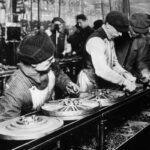
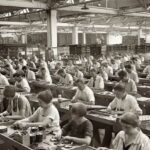
- Serial production . A new production system called “Serial Production” or “Chain Production” was implemented, which used the assembly chain and a rational work division to increase productivity in factories.
- Transport development . The increase in steel production for the construction of rail lines and vessels, as well as the use of new fuels and the invention of the car and the plane with internal combustion engines, brought with them a transport development never seen before.
- New materials and energy sources . Technical and chemical innovations (such as oil and electricity) involved the use of new materials and energy sources.
- Telecommunications . There was an important transformation in the area of telecommunications thanks to the invention of the telephone and radio, in addition to other innovations such as the phonograph and the cinematographer.
Main inventions of the second industrial revolution

The innovations of the second stage of industrialization caused profound changes in production, transport, communications and ways of life and leisure. The main inventions of the second industrial revolution were:
- The internal combustion engine . The exploitation and distillation of oil allowed to obtain gasoline, a fuel that began to be used in internal combustion engines that enabled the invention of cars and airplanes. The first internal combustion engine based on gasoline was developed by the German Nicolaus Otto in 1876.
- The car . The internal combustion engine was first incorporated into a car in 1886 by German engineer Karl Benz. The car was perfected by the American Henry Ford when he launched his Ford T model in 1908.
- The plane . Aviation was the result of many years of experimentation, but it was at the beginning of the 20th century that the development of engine aircraft began, which changed forever airspace. The Wright brothers (United States) were the first to achieve a sustained flight with a heavier mechanical plane than air in 1903.
- The electric tram . Electric power did not steam for the operation of the railroads, but promoted the invention of a new type of urban passenger transport: the electric tram. The first road of an electric tram was inaugurated in Berlin in 1881.
- The telegraph . Although it was invented before the Second Industrial Revolution, this apparatus for the transmission of distance coded messages by electrical signals was disseminated during the second half of the nineteenth century, thanks to the system designed by the American Samuel Morse.
- The radio . The verification of the existence of electromagnetic waves by the German Heinrich Hertz in 1887 allowed the invention of the wireless telegraph and the development of the radio by the Italian Guillermo Marconi at the beginning of the 20th century.
- The phone . This telecommunication system was patented by the Scottish Alexander Graham Bell in 1876 and became popular in the twentieth century.
- The phonograph . Invented in 1877 by the American Thomas Alva Edison, it was the first device that allowed to record and reproduce sound. He was soon surpassed in quality by the gramophone patented by Emile Berliner in 1887.
- The cinematographer . The first device that allowed to film and transmit a moving image without sound was invented by the Lumière brothers in France in 1895.
- The electric bulb . At the beginning of the second industrial revolution, the exploitation of oil popularized the use of chest lamps (a liquid obtained from oil). However, research in the field of electricity motivated experimentation with electric lamps. In 1879, the American Thomas Alva Edison invented a type of incandescent carbon filament lamp that was useful for public and domestic lighting.
- Dynamite and TNT . In 1867, the Swedish chemist Alfred Nobel patented the dynamite, an explosive made of nitroglycerin that was safer than this and more powerful than the black powder. It began to be used mainly in mining. Another explosive developed at this time was the TNT (Trinitrotoluene), which was also used in military artillery.
Advances of the Second Industrial Revolution
The mechanization arising with the first industrial revolution was deepened with the second. In addition, the new technological inventions, the use of new energy sources and the new work organization techniques favored the emergence of new industries.
Many of these innovations benefited from advances in science and chemistry and allowed the development of telecommunications and new means of transport.
1. Work mechanization

The new production system, introduced during the second industrial revolution to accelerate times and reduce costs, was based on the model of the American Frederick Taylor, commonly known as taylorism or scientific organization of work. Was a serial production model in which each worker had to make a part of a piece within a assembly chain and in a certain time (controlled by chronometers). It was a new form of work mechanization.
In 1901, businessman Ransom Olds first used the assembly line and, shortly after, the automotive factory Ford Motors Company adopted for the manufacture of the Ford T model while perfecting the assembly line by incorporating a conveyor belt and increased the workers’ salary. Henry Ford’s idea was that each worker should gain enough to be able to buy one of the cars he made, which guaranteed an increase in consumption.
This productive system was known as Fordism And it had huge consequences: it reduced production costs and multiplied the amount of cars manufactured and sold. In 1908, Ford T cars had been manufactured in a month, while in 1910 more than 10,000 were manufactured and, in 1914, around 250,000. The assembly time of each car had spent twelve and a half hours to 93 minutes, and its price dropped proportionally.
2. Transportation

One of the most obvious characteristics of the second industrial revolution was the expansion of the railways, which thanks to the growing use of steel, favored the movement of products and people. England specialized in rail construction and dedicated himself to exporting rail supplies to other countries. The generation of electricity also allowed the invention of the electric tram for urban passenger transport, whose first road was inaugurated in 1881 in Berlin.
The ships began to be built with steel And the steam turbine was invented, which allowed them to be larger, that they had faster speed and that the maintenance cost was lower. Throughout the twentieth century, the use of oil in navigation was increased.
Besides, The new fuels allowed the development of the internal combustion engine that used gasoline included for the first time in a car model in 1886, by the German engineer Karl Benz, and perfected with the Ford T model that the American Henry Ford designed in 1908. Aviation was also developed from the innovations introduced during the second industrial revolution.
3. New energy sources

Two of the most important innovations of the second industrial revolution were oil exploitation and distillation, and industrial electricity generation.
Oil
In 1848 the Scottish chemist James Young had a small business that refined crude oil. While there were some background in China, it was from this moment on, and the development in 1859 of the method for drilling wells of the American Edwin Drake, which, which The technique that allowed the drilling of wells extended throughout the world .
One of the oil -derived fuels was kerosene, used for lighting (it was more efficient and less expensive than vegetable oils). Also allowed to prepare gasoline for internal combustion engines (cars and airplanes). The growing importance of oil gave rise to Standard Oil, one of the first multinational monopolistic trends.
Electricity
The industrial generation of electricity was the other great innovation of the period, the result of studies and experiments carried out by various researchers. Thomas Alva Edison was the one who invented in 1879 a type of incandescent lamp of carbon filament which allowed its use for public and home lighting.
This method replaced the old lighting system with kerosene and transformed life into cities and factories. Electric power It also enabled other innovations, such as telephone, radio or tram .
4. New materials
Some of the new or popular materials during the second industrial revolution were:
- Steel . Obtaining steel from iron alloy with small amounts of carbon was prior to the second industrial revolution. However, in 1856 the English engineer Henry Bessemer discovered a way to obtain steel in large amounts already low costs, and in 1865 a group of engineers invented a more controlled method. The incorporation of electric ovens at the end of the 19th century further perfected steel production, whose use was generalized in the construction of high -rise buildings, vessels and railways.
- The zinc . Zinc was already known but was very important during the second industrial revolution to cover other metals, mainly iron and steel, and protect them from corrosion (process known as “galvanization”).
- Aluminum . During the second half of the nineteenth century, advances in the extraction of this metal were produced, especially through the use of electricity, which allowed to increase its production. Its light and corrosion resistant character made it a useful material for its application in vehicles and construction, in addition to serving as an electricity driver.
- The nickel and chromium . Both nickel and chromium were previously used metals but, at the beginning of the 20th century they began to be used to obtain stainless steel.
- The vulcanized rubber . Vulcanization was a process prepared by the American Charles Goodyear in 1839 that allowed the hardening of rubber. The vulcanized rubber was widely used during the second industrial revolution for conveyor belts, cable insulation and car wheels.
- The first plastics . One of the first plastic materials was the celluloid, developed by the American John Wesley Hyatt in the 1860s and 1870s. In 1907, the Belgian Leo Baekeland invented the baquelita, a thermoplastic capable of being molded while it was hot, but which hardens when it cool, which is considered the first totally synthetic polymer.
5. Telecommunications

Among the most important innovations of the second industrial revolution are those that occurred in telecommunications.
- The telegraph . Invented before the second industrial revolution, the telegraph gained popularity thanks to the system developed in 1837 by the American Samuel Morse, creator of the “Morse Code”. The artifact allowed communication instantly through a language of points and lines. It reached a great impact on the main cities of the world, where wired extensive, initially for the use of railroads.
- The radio . The German Heinrich Hertz verified the existence of electromagnetic waves and the Italian Guillermo Marconi applied this knowledge to the development of a wireless telegraph, which gave rise to the radio at the beginning of the 20th century.
- The phone . In 1876, the Scottish engineer Alexander Graham Bell patented the telephone in the United States, a telecommunication device designed to transmit conversations through electrical signals. While some researchers suggest that the invention was prior to Graham Bell’s patent, the truth is that this device became increasing importance throughout the twentieth century.
- The cinematographer . In 1895, the Lumière brothers created in France the first cinematographer that transmitted image without sound. The first film they broadcast was called “Departure from the workers from the Lumière factory.” From then on, the cinema was a means of expression and communication of great influence.
6. Advances in science and chemistry
The scientific research of the time of the second industrial revolution not only influenced production and communications, but also in health and medicine, because allowed to control or reduce diseases and thus extend life expectancy.
In 1864 the chemist Louis Pasteur created a process for food conservation called “pasteurization”, which allowed destroying microorganisms and bacteria, without altering the original composition of the substance. His studies in microbiology also influenced the development of vaccines and antibiotics.
In 1882 the doctor and microbiologist Robert Koch discovered the bacteria that caused tuberculosis. In 1897 the chemist Felix Hoffmann synthesized acetylsalicylic acid That, two years later, the Bayer company patented with the name of aspirin.
Experiments and research in the area of chemistry also promoted The development of fertilizers for agricultural production and explosives that served in mining and military activity, for example during World War I. Some of these investigations allowed the subsequent development of nuclear weapons, such as the one used during World War II.
Causes of the Second Industrial Revolution
The main causes of the second industrial revolution were the dissemination of industrialization beyond Great Britain (where it had begun), the invention of new techniques and technologies, the emergence of an industrial business and a modern financial system.
Other factors that favored this process were the political role of the bourgeoisie, the availability of raw materials at local and colonial levels, and the growth of the urban population (which increased the demand for goods and services).
- Industrial expansion and new inventions. There was an expansion of the technical and technological innovations of the first industrial revolution to various regions of the world, especially to the United States, Western Europe and Japan, which allowed new research and inventions to occur.
- Emergence of modern entrepreneurs and banks. The accumulation of wealth, the interest in obtaining profits and the improvement of the economic management of industrial entrepreneurs, added to the expansion of international trade and the financial system, favored capital investments.
- Political ascent of the bourgeoisie. The political changes in Europe, such as the third republic in France (1870) and unification in Germany (1871), allowed the rise of industrial bourgeoisies and economic modernization. In Germany there was a strong incentive to the industry through protectionist policies.
- Availability of raw materials. Access to raw materials, both at the local level (for example, cotton and oil in the United States or iron and coal in Germany) and at the colonial level (for example, cotton from India exported to England), had a fundamental importance to supply industrial production. The second industrial revolution promoted an imperialist career among European powers to obtain raw materials in regions of Africa and Asia.
- Demographic growth and increase in demand. The growth of the urban population at unprecedented levels entailed the increase in the demand for goods and services in cities, which stimulated an increase in industrial production.
Consequences of the second industrial revolution

The main consequences of the second industrial revolution were the increase in the productivity of companies, the increase in unemployment, the expansion and modernization of cities, mass consumption, the continuous development of technological innovations, the organization of the labor movement, the worldwide expansion of capitalism and the military use of new technologies.
- Productivity increase. The systematic production developed during the second industrial revolution resulted in the acceleration of production, which increased the competitiveness of large companies in the market.
- Increase in unemployment. The replacement of employees with machinery generated unemployment during the second industrial revolution.
- Expansion and modernization of cities. The extension of the phenomenon of urbanization extended the number of large cities, even more populated and modernized through the use of electricity for lighting, transport (electric tram) and communications (telephone); the construction of large engineering works (such as wrought iron or steel bridges); And, in cities such as New York or Chicago, huge skyscrapers (possible thanks to the steel industry, reinforced concrete and the invention of the elevator).
- Mass consumption. The use of new technology encouraged mass consumption, both products and entertainment (such as cinema and radio), and promoted other innovations that changed life forms throughout the twentieth century.
- Development of technological innovations. The new techniques and technologies were the basis of constant innovations that continued to modify production and consumption throughout the twentieth century, such as the improvement and acceleration of the means of transport.
- Strengthening of the labor movement. The initiative of socialist and anarchist unions gave impulse to the organization of the labor movement, which sought to deal with the growing labor exploitation and unemployment, and had the objective of improving the standard of living of workers and claiming a better distribution of wealth. In some cases, these claims were linked to the purpose of conquering political power or transforming social order.
- World expansion of capitalism. The second industrial revolution was the worldwide expansion of capitalism, which favored industrial countries that produced manufactures. In addition, he accompanied the phenomenon of imperialism that, among other things, promoted Africa’s distribution among the great powers of Europe.
- Military use of new technologies. When World War I broke out in 1914, the technological advances that were part of the second industrial revolution shapes a new type of conflict, much more lethal than the previous ones due to the use of new technologies.
Differences between the first and second industrial revolution
Although the second industrial revolution was largely an acceleration of the changes introduced by the first industrial revolution, both processes had some significant differences.
The first industrial revolution meant the emergence of large -scale mechanized work, the birth of factories, the transformation of transport and the formation of large industrial cities in England.
Instead, During the second industrial revolution, the phenomenon of industrialization to other countries expanded the rhythm of technological innovations accelerated, production techniques were perfected, new materials and energy sources were incorporated, new means of transport and communication were invented and cities grew much more.
Next, we show you the main differences between both periods in this comparative table:
| Aspect | First industrial revolution | Second Industrial Revolution |
|---|---|---|
| Geographical location | England | Germany, United States, Japan, France, Belgium, England |
| Technological innovations | Steam machine, textile machines, gas lighting | Internal combustion engine, electricity, chemical industry, telecommunications (telephone, radio) |
| Energy sources | Mineral coal | Mineral coal, oil, electricity |
| Outstanding industries | Textile industry, mining, iron metallurgy, transport (rail and steamboats) | Siderurgy (steel), chemical industry, electricity industry, telecommunications (telephone, radio), transport (cars, airplanes, electric trams, steel ships) |
| Outstanding technical innovation | Mechanization of work in factories | Serial production, assembly chain, use of electricity in factories |
Third industrial revolution
A third stage of changes, known as the third industrial revolution or digital revolution, took place in the 1970s and 1980s.
Its main feature was the introduction of digital technology and computer science . In the field of production, this innovation promoted industrial automation (that is, the development of automatic machines that could perform all kinds of tasks, such as manufacturing parts for other machines).
The dissemination of computer science marked a revolutionary change in communications and services. In the 1970s the manufacture of personal or domestic computers began, marketed in the most industrialized countries (such as the United States and Japan). The first cell phones were also manufactured.
In the 1990s, computers were disseminated and the system era began world Wide Webwhich extended the use of the Internet . The era initiated with the third industrial revolution is usually called “Era of information.” Other innovations of the third industrial revolution were biotechnology (living substances manipulation techniques for food or pharmaceutical production) and energy engineering (the search and development of new energy sources).
References
- Britannica, Encyclopaedia (2022). Industrial Revolution. Britannica Encyclopedia. https://www.britannica.com
- Coriat, B. (1982). The workshop and the stopwatch. Essay on Taylorism, Fordism and mass production. 21st century.
- Hunt, L., Martin, Tr, Rosenwein, BH & Smith, BG (2016). The Making of the West: Peoples and Cultures. 5th edition. BEDFORD/ST. Martin’s.
- Mkyr, J. (1999). The Second Industrial Revolution, 1870-1914. Storia Dell’economia Mondiale. https://en-econ.tau.ac.il
Continue with: