
We explain everything about Venezuela, and its physical and cultural characteristics. In addition, how is its economy, religion and the history of this country.
Venezuela
Venezuela is a national state whose official name is Bolivarian Republic of Venezuela . Its capital is the city of Caracas . It is located in northern South America, and limits to the east with Guyana, to the south with Brazil and to the west with Colombia. This is the sixth largest country and the fifth most populous in South America.
Formally, Venezuela is a federal presidential republic. However, at present, his government is described by various international sources and human rights organizations as an authoritarian system . The country was part of the ancient Spanish colonies in America and was one of the first South American nations to proclaim its independence in 1811, when it was part of the Gran Colombia along with the New Granada (today Colombia), Panama and Ecuador.
Its Constitution dates back to 1999 and according to it it is a democratic federal state whose gentilicio is “Venezuelan.” He is a full member of the United Nations Organization (UN) and is part of Mercosur, CELAC (Community of Latin American and Caribbean States) and ALBA -TCP (Bolivarian Alliance for the Peoples of Our America – Treaty of Commerce of the Peoples).
Why is it called “Venezuela”? The name of Venezuela comes from Venice and literally means “small venecia”, a pseudonym often used in tourist promotions and local songbooks. It is attributed to Américo Vespucio, who would have thought of the Italian city when seeing the suspended indigenous palafitos over the waters of Lake Maracaibo, to the west of the country.
Characteristics of Venezuela
Some characteristics of this country are:
- Its population is 28,500,000 inhabitants. Most concentrate on the coastal regions of the north of the country.
- It has an area of 916,000 km2.
- Its capital is Caracas, which has 3,100,000 inhabitants. Its metropolitan area exceeds 5 million inhabitants.
- Its predominant climate is the warm tropical.
- Its relief is very varied: mountains and volcanoes in the west and north, an old massif elevated in the south, and the plain of the Orinoco river in the center of the country.
- Venezuelan culture is influenced by the Spanish conquest, native peoples and African culture.
- Its majority religion is the Catholic.
- The official language is Spanish.
- Its official currency is the sovereign bolivar.
- Its main economic activity is oil production and export.
Extension, population and capital of Venezuela

Venezuela has an extension of 916,000 square kilometers and a population of 28,500,000 inhabitants. Its population density is 31.1 inhabitants per square kilometer.
The capital of Venezuela is the city of Caracas . His official name is Santiago de León de Caracas. Its metropolitan area has a population of 5,400,000 inhabitants, representing 18.9 % of the country’s total.
The population is concentrated in the north of the country, On the coasts on the Caribbean Sea. The south of the country, in the border regions with Guyana, Brazil and Colombia, is much less populated. With the Republic of Guyana, Venezuela maintains territorial disputes through the Esequiba Guyana region .
The Venezuelan territory is divided into 23 federal states —Ean one endowed with capital and under the administration of a governor – and a Federal District in which the city of Caracas (the “great” Caracas, to cover its entire metropolitan area), under the mandate of a metropolitan mayor.
The three most populated states are Zulia, with 3,600,000 inhabitants, Mirandacon 2,800,000 and Carabobocon 2,300,000. The most depopulated are Amazonas, with 84,000 inhabitants, Delta Amacuro with 116,000 and Cojescon 315,000.
Besides, It has twelve federal units outside the continental territory which include 216 islands, islets and keys. One of the best known is the Los Roques archipelago, located in the Caribbean Sea, one of the most important tourist destinations in the country.
Climate, relief and hydrography of Venezuela
Venezuela’s climate is mostly warm tropical . The north of the country has a warm tropical climate of Sabana, while the South has a warm equatorial tropical climate.
Both climates are characterized by having high temperatures all year with the difference that the tropical of Sabana has a marked dry season in winter, while the equatorial has abundant rains throughout the year.
In some regions of the Andes, the subhumid temperate climate of mountain can be found, which is characterized by abundant rains but with lower temperatures due to the influence of height.
As for the relief, three geologically different regions can be identified:
- The Andes mountain range. It forms a mountain chain that is located in western Venezuela and bifurca to form the mountains of Perijá and Motilones and west that of Mérida. In addition, it presents two parallel mountain ranges to the coast, that of the coast and the interior.
- The Guyana Massif . It is made up of an extensive high plateau that occupies almost half of the Venezuelan territory. It is formed by very old rocks that belong to the Precambrian and Paleozoic era.
- The Orinoco plain . It is between the two previous regions. It is formed by the Orinoco River and its altitude does not exceed 200 meters above sea level.
With more than 2000 kilometers of extension, The Orinoco River is the most important in Venezuela . Born in the south of the country and flows into the Delta -shaped Atlantic Ocean. Other important rivers are Caroní, Apure and Meta.
The flora and fauna of Venezuela are characterized by its rich biodiversity. Abundant rains and high temperatures favor the development of dense wet forests and jungles that house a large amount and variety of species of plants and animals.
Mainly in the south of the country, where part of the Amazon jungle is, biodiversity is very abundant. Species such as orchid and cocoa plant, fundamental to the country’s economy, and animals such as snakes and crocodiles.
A lake or a bay? In Venezuela is Lake Maracaibo, which with 13,800 square kilometers of surface is the largest in Latin America. However, there are discussions about whether it is a lake or a bay, since it is connected to the Caribbean Sea at its north end and has characteristics more similar to those of the seas, by its tides and the high salinity of its waters. Those who believe that Maracaibo should be considered as a lake argue that their formation is not related to the ocean, but that its geological origin is that of a lake and is also fed by fresh water rivers.
Culture of Venezuela
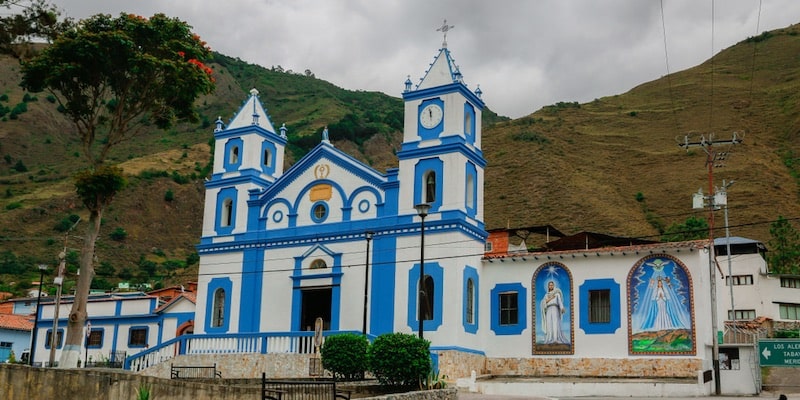
The Venezuelan population is diverse And it is made up of European, African, indigenous and Asian ethnicities, as well as a mestizo majority of the colonial era. The predominant religion of Venezuela is the Catholic Christian but there are also religious minorities such as Judaism, Islam and Buddhism.
In the field of music, Venezuela stands out for a variety of traditional and folk rhythms with influences of pre -Columbian, European and African culture. One of the most recognized genres is the joropo originally from the Los Llanos del Orinoco region. Other traditional rhythms are Venezuelan and calipso.
Among the greatest exponents of Venezuelan plastic art is the painter and sculptor Armando Reverón and Carlos Cruz-Diez, recognized exponent of kinetic art. In the branch of literature, the writer Andrés Eloy Blanco and the writers Teresa de la Parra and Mió Vestrini stand out.
The gastronomy of Venezuela reflects the cultural diversity of the country. Arepa is one of the most emblematic dishes made with corn dough, which can be filled with a wide variety of ingredients such as meat, chicken or cheese. Other traditional dishes are the Creole pavilion and the hallaca.
Homeland symbols of Venezuela
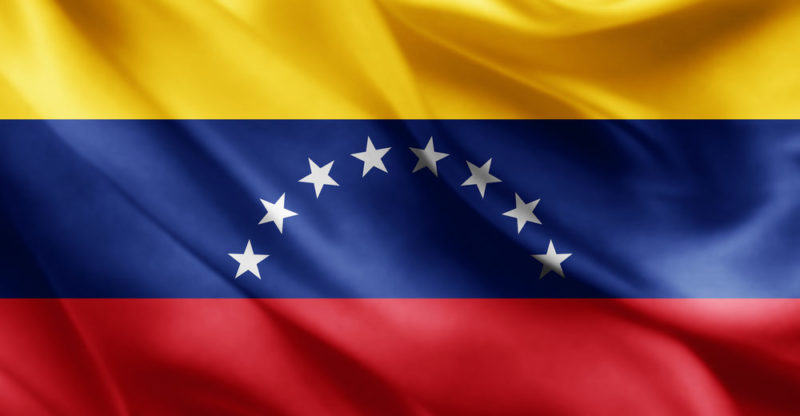
Venezuelan national symbols are:
- The flag of Venezuela . As well as the other countries that were part of the Gran Colombia (Colombia and Ecuador), the Venezuelan flag consists of three stripes, a yellow, one blue and a red one, with eight stars in semicircle in the intermediate strip that represent the provinces that formed the American Confederation of Venezuela in independence times.
- The anthem of Venezuela . The Venezuelan anthem is titled “Glory to the Bravo People!” It was written in 1810 as a patriotic war of war and was officially established in 1881 during the government of Antonio Guzmán Blanco. Its composition, lyrics and music are attributed to Vicente Salias and Juan José Landaeta, although its current version corresponds to that modified by Jan Bautista Plaza (1947).
- The Venezuela Shield . The current shield carries the colors of the flag in its three dividing fields, called barracks, in which they are: a white horse in the race to the left; a bunch of Mieses with as many spikes as states of the Republic; And two national flags crowned by a laurel, next to a machete, a spear, a sword, an arc and an arrow inside a laugh.
Economic activities of Venezuela
The official currency of Venezuela is the Sovereign Bolivar. The most important economic activities of Venezuela are:
- Agriculture . Crops such as cocoa, coffee, corn, rice, sugar cane and tropical fruits stand out.
- Mining . It is a fundamental economic activity for the Venezuelan economy, and constitutes one of the main export sectors of the country. Minerals such as iron, bauxite and gold stand out.
- The petrochemical industry . Oil production is the main activity of the Venezuelan economy. He is the main producer of South America and one of the most important in the world with almost a million barrels of oil per day.
- Tourism . The Caribbean beaches represent a great tourist attraction for visitors who arrive in Venezuela. The Los Roques and Margarita Island archipelago, among others, are some of the most important tourist sites in the country. The jump of the angel is also very visited, since it is the highest waterfall in the world.
History of Venezuela
The Venezuelan territory was inhabited by Arahuacos and Caribes peoples when the Spaniards arrived at the end of the fifteenth century . The colonization was carried out throughout the 16th century through the parcel regime and a system of provinces governed by the Royal Audience of Santo Domingo was established. In 1567 Caracas was founded.
In 1717 the Venezuelan territory became part of the Viceroyalty of New Granada and in 1777 it became general captaincy of Venezuela. The colonial economy was largely based on the export of sugar, cocoa and tobacco.
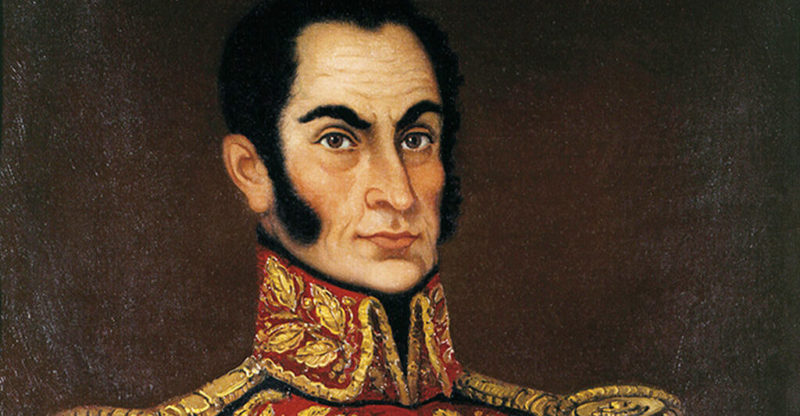
Francisco de Miranda tried unsuccessfully to initiate the struggle for independence in 1806. In 1810 a Governing Board was formed and on July 5, 1811 the act of independence of Venezuela was signed. The war between independence and realistic concluded in 1823 with The victory of the independence forces led by Simón Bolívar.
Initially, Venezuela was part of Gran Colombia along with Ecuador, Colombia and Panama under the command of Bolívar but separated in 1829. The first president of the state of Venezuela was José Antonio Páez. In 1854, slavery was abolished and, throughout the 19th century and until the beginning of the 20th century, governments of leaders, uprisings and civil wars (such as the federal war between conservatives and liberals).
During the dictatorship of Juan Vicente Gómez (1908-1935) he went from the agro-export model to an economy dependent on oil export, as exploitation contracts were granted to US and British companies. Venezuela became one of the largest oil exporters but did not improve the living conditions of the most impoverished sectors.
After another stage of instability, in 1958 a democracy with political alternation was established. In the 1970s the price of oil and the government nationalized its exploitation increased. In the 1980s, the economic crises that led to demonstrations such as Caracazo (1989) and two attempts of coups (1992) began.
In 1999, President Hugo Chávez was elected, who promoted a new Constitution founded by the Bolivarian Republic of Venezuela. After Chávez’s death in 2013, the presidency Nicolás Maduro assumed in the context of an economic and political crisis that stimulated mass emigration.
Continue with:
References
- Ministry of Foreign Affairs (2023) Venezuela. Country record. Diplomatic Information Office of Spain. https://www.exteriors.gob.es/
- Portillo, S. (2020) Flora and Fauna of Venezuela. https://www.ecologiaverde.com/
- ALBA website – TCP https://www.albatcp.org/
- CELAC website https://celacinternational.org/
- Snesshko, M (2022) 5 Venezuelan writers you must know. https://oceandrive.com.ve/


